As longtime readers of this Substack are well aware, despite the official consensus, there exists a dementia and Alzheimer’s Disease cure in plain sight.
Even those in the alternative health space, and medical freedom movement are unaware of this treatment protocol; for example:
…but for the purposes of this article, we shall focus on the anti-aging, anti-autism, and anti-Alzheimer’s properties of low dose lithium orotate.
Firstly, let us look at administering low dose lithium orotate for autism spectrum disorder:
A groundbreaking discovery has highlighted lithium - a drug long used to treat bipolar disorder and depression - as a potential therapy for autism spectrum disorder (ASD). This research, conducted by a team at the Center for Synaptic Brain Dysfunctions within the Institute for Basic Science (IBS) led by Director KIM Eunjoon, reveals that lithium can restore brain function and alleviate behavioral symptoms in animal models of ASD caused by mutations in the Dyrk1a gene.
Our work highlights that early lithium treatment triggers mechanisms through which multiple signaling and synaptic proteins exert long-lasting rescue effects in this model.
While this study wrongly postulated that a mutated gene is causing autism spectrum disorders, the key extrapolation here is that administering low dose lithium orotate (not the high dose bipolar drug) will attenuate autism symptoms, with greater potential benefits the earlier this strategy is deployed in a person’s life.
Imagine a drug company working on a pill to prevent progression to Alzheimer dementia for patients at high risk. Imagine that their animal studies show benefit in preventing neurodegeneration, reducing 2 of the major changes known to lead to Alzheimer disease: tau protein phosphorylation and amyloid plaque formation. Imagine that their new drug had been shown to inhibit these 2 changes in humans, in a preliminary trial; and that so far, there were no known risks of their new medication, and no side effects in over 90% of patients.
Wouldn’t some patients and their families be interested in getting hold of this drug, even as formal clinical trials were getting underway?
That would surely be the case if the drug was already known to carry very low risk and unlikely to produce significant side effects. Because what else is there to do, when a patient and his or her family are facing likely decline into a progressive series of losses and stress-with no hope of reversing the process?
When such a drug was shown to have the desired effect in even a small sample of patients who already exhibited very early signs of the illness-to a greater extent than placebo-well, that would begin the stampede, would it not? The company would be besieged with requests that would likely soon turn into demands for humanitarian release of their new product, based on the extremely large number of adults at very high risk for Alzheimer disease in the next decade.
There would be calls for prudence: “This is just one trial; we need a replication.” That call would be drowned out by objections: “What else do you think we are going to do? If there’s even a 1% chance this could work, we’re ready to take it. Even if there was significant risk, we’d be ready to take it: why not? Why just wait for an inevitable decline?”
As you’ve surely gathered, there is indeed a randomized trial that shows lithium prevented cognitive worsening in patients with minimal cognitive impairment (MCI).1 The dose was roughly 1.5 mg of lithium carbonate per day: microdose lithium.1 Yet when one of my patients with MCI, who has been taking 300 mg/d of lithium for more than 5 years, was evaluated by a university dementia research program (he was debating whether to enter one of their clinical trials), they pooh-poohed the lithium. His blood level was 0.1 mEq/L. Not enough data to support this approach, they said-and they’re not alone in their opinion.2 I cannot understand this logic: what else have we got to offer? But new data may further tilt the balance.
The same Brazilian research group who performed the human trial has recently shown, in mice genetically engineered to have an equivalent of early Alzheimer disease (early development of amyloid plaques with attendant cerebrovascular, cognitive, and neuroinflammatory pathologies), that microdose lithium in their water supply prevented progression to disease to a dramatic extent.3 In addition to demonstrating that lithium attenuated the deleterious brain changes in the genetically engineered animals, they also found that the treated animals’ behavior was no different from that of “wild type” mice (ie, those not genetically altered).
This may strike you as backward: why the human study first, then the animal study? Answer: the group is working on demonstrating the value of lithium as a preventive agent in patients at risk for Alzheimer disease. Their first study in humans used low-dose lithium (blood levels of 0.25 to 0.5 mEq/L).4 Their follow-up human study used the microdose referenced above. They had to go back and show, in mice, that microdoses produced the same brain benefits seen in earlier mouse studies with larger doses.5
If more people knew of this Alzheimer research, hesitation might decrease substantially.
Why is there so little clamor from patients at high risk for Alzheimer disease and their families for microdose lithium? Might it be because this is lithium, with all its historical baggage and the stigma of being associated with bipolar disorder?
Whatever the reason, these data further establish that “the magic ion”6 in even tiny doses is psychoactive. Perhaps such data will increase willingness to use lithium for patients with bipolar disorder, especially in low doses. And that, after all, is my point: lithium is underutilized in depression and bipolar disorders. If more people knew of this Alzheimer research, hesitation might decrease substantially.
The only hesitations are on behalf of the Medical-Industrial Complex, their BigPharma partners-in-crime and the captured doctors that prefer to keep their heads buried in the proverbial sands so as to never offer inexpensive compounds that actually work (see also: the repurposed and inexpensive cancer cure that this Substack all too frequently writes about).
In our case series, when low-dose lithium was used as an add-on to antipsychotic treatment, several symptoms improved: auditory hallucinations, visual hallucinations, paranoia, anxiety, anger/aggression, agitation, impulsivity, and physical violence. It remains unclear if lithium is effective in the treatment of symptoms of agitation and psychosis in dementia by itself or if its effectiveness is related to concomitant antipsychotic use. A common clinical scenario is the difficulty in increasing the dose of antipsychotics when side effects develop; our case series suggests that adding lithium is an option that should be considered. For example, case 6 became violent and self-injurious by ingesting inedible materials. Treatment with antipsychotics was unable to successfully treat these symptoms, but adding low-dose lithium markedly reduced these behavioral disturbances.
Lithium has inhibitory effects on glycogen synthase kinase-3 (GSK-3) and tau phosphorylation,15,16 leading to interest in lithium as a possible neuroprotective agent for tauopathies including AD and subtypes of FTD. The mechanism of action for lithium as a treatment for agitation remains unclear, partly because lithium has a multitude of neurotransmitter effects in the brain.9,15
In patients without dementia, lithium is an effective treatment for agitation and other behavioral disturbances associated with several psychotic disorders.9 In our case series, short-term to intermediate-term follow-up indicated that lithium was effective in treating agitation and other behavioral disturbances. The findings support the need for a randomized, double-blind, placebo-controlled trial to evaluate lithium as a treatment for agitation in subtypes of dementia including AD and FTD.
As this Substack featured last year in the following article…
The journey of evidence-based medicine, particularly in the treatment of complex diseases such as cancer and Alzheimer’s, is marked by pivotal shifts in approach and philosophy, many of which can be traced back to the early 20th century.
…just like the research study conclusion regarding glycogen synthase kinase-3 (GSK-3) and tau phosphorylation, combining Ivermectin and Fenbendazole with low dose lithium orotate address a broad range of tau protein pathologies; to wit:
Potential strategies include kinase inhibitors that reduce tau phosphorylation, tau aggregation inhibitors that prevent the formation of NFTs, and immunotherapies designed to clear tau aggregates from the brain. Each approach targets a different aspect of tau pathology, offering potential pathways to slow or halt the progression of Alzheimer’s Disease.
And as the case study confirms, lithium is an effective treatment for agitation and other behavioral disturbances associated with a variety of psychotic disorders, thus making it an extremely powerful mood enhancing compound that has a safety profile, just like Ivermectin and Fenbendazole, that is far superior to common OTC drugs such as aspirin.
A couple of months ago, apparently almost unbeknownst to many experts and largely unnoticed in the public, a paper was published that may fundamentally change dementia care (Forlenza et al. 2019). In the article, Forlenza and his co-workers from Sao Paulo describe a double-blind, placebo-controlled trial of low-dose lithium among patients with mild cognitive impairment (MCI) aimed at slowing cognitive decline and ultimately at preventing progression to dementia.
After 2 years, while cognition remained stable in lithium treated patients, as evidenced by common cognition scales, patients receiving placebo exhibited continuous decline. In an open-label extension phase, 4 years into the study, five out of 31 subjects in the lithium group and 9 out of 30 under placebo had progressed to dementia.
Cutting in half the risk of transition from MCI to dementia?
[…]
Taken together, in a disorder where we can offer so little to patients, the effect sizes presented by Forlenza et al. are substantial, encouraging and a rare silver lining. Given the uncertainties in this study and the fact that effect sizes can be larger in early and small studies, we do not know whether the results will hold, and we probably won’t know until 2022 when a very similar study in Pittsburgh is scheduled to end (Lithium As a Treatment to Prevent Impairment of Cognition in Elders–Full Text View–ClinicalTrials.gov: Accessed Sept 17 2019). Until then, let us all hope that lithium, this remarkable alkali metal, will turn out to be crucial not only for patients with bipolar disorder and for batteries, and that future primers of lithium treatment will contain a recommendation to use lithium salts in the treatment of MCI.
It is vital to distinguish between the bipolar disorder prescribed lithium, which is extremely high dose, and the benign and healthful low dose lithium orotate, which, unlike the prescribed drug, has neuroprotective and life extension properties.
Low-dose lithium shows promise in preventing dementia and reducing suicide risk, with evidence supporting its neuroprotective effects.
Microdoses of lithium may address a potential deficiency, improving mood, irritability, and cognitive function.
Lithium’s role in addiction recovery includes reducing medication use and improving treatment outcomes.
Research supports lithium’s efficacy in treating resistant depression, with benefits observed even at lower doses.
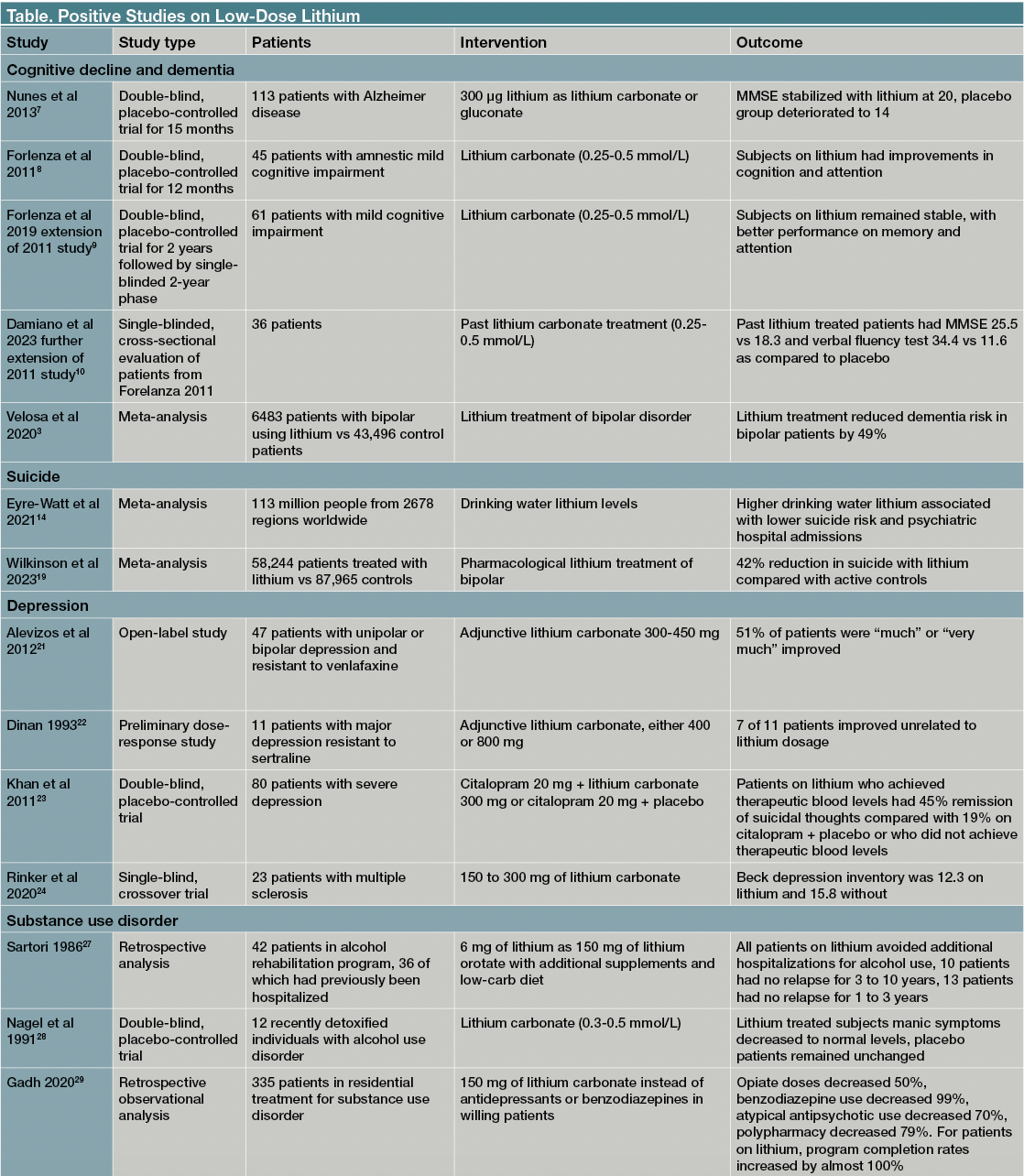
Arguably, the strongest evidence for low-dose or even nutritional doses of lithium is for the prevention of dementia and suicide. Recent research and my own clinical experience have demonstrated additional clinical applications, including for depression, substance use disorder, and irritability (Table).
Defying Cognitive Decline: How Low-Dose Lithium May Prevent Dementia
Initial evidence for the effects of lithium on cognitive decline and dementia were uncovered in patients with bipolar disorder. Bipolar is well known to increase the risk of developing dementia. An analysis from 2020 found that a diagnosis of bipolar disorder tripled the risk.3
In contrast, studies on patients with bipolar disorder who were on lithium as a mood stabilizer found that lithium treatment significantly reduced the risk of dementia.4 Based on the findings, clinical trials started exploring the use of lithium as a direct treatment for Alzheimer disease. While some of the initial studies were mixed,5,6 further clinical trials have found benefits for slowing or halting the progression of cognitive decline with lithium treatment.
A trial by Nunes et al even found potential benefits with 300 µg of lithium per day.7 At this microdose, patients with Alzheimer disease remained stable over 15 months as patients on placebo continued to decline. At the end of the study, Mini-Mental State Examination (MMSE) scores had dropped to 14 in the placebo group, whereas the lithium group held steady at just below 20.
In 2011, a trial of low-dose lithium for cognitive decline also found benefits.8 Treatment included 12 months of low-dose lithium, with blood levels between 0.25-0.5 mmol/L. As compared with placebo, lithium-treated subjects had a decrease in phosphorylated tau in cerebrospinal fluid (CSF) and better cognitive function.
After additional data was collected on the same subjects over the next 2 years, outcomes were further improved.9 Placebo patients worsened, whereas the patients on low-dose lithium remained mostly stable. Memory and attention were significantly better with lithium. Lithium also increased levels of amyloid-beta peptide in the CSF at 3 years. The increase was hypothesized to be due to an increased clearance of amyloid plaques with long-term lithium treatment.
The final analysis of these patients was published in 2024.10 While a significant subset of patients had died, the patients who had received lithium had higher MMSE scores vs those who were given placebo: 25.5 vs 18.3, respectively. Verbal fluency testing also showed marked advantages with lithium treatment with scores of 34.7 vs 11.6.
One of the most recent meta-analyses for patients with bipolar disorder found that pharmaceutical lithium reduces dementia risk by half.3 A separate meta-analysis of both the preclinical and clinical research found that lithium displays neuroprotective effects with clinical data showing positive results in patients with Alzheimer disease.11
Increasing cases of Alzheimer disease and dementia are one of the more sobering realities we face in medicine, as cases are projected to increase precipitously over the coming decades.12 Considering the challenges of our aging population, lithium may be a cost-effective augmentation strategy to fill treatment gaps for dementia prevention initiatives.
A Life-Saver in Microdoses: The Potential of Lithium in Suicide Prevention
Beyond the potential benefits for cognitive health, lithium may also be useful for another significant unmet need: suicide prevention. Suicide rates have been mostly on the increase in the United States since 2001.13 Suicide is the second leading cause of death among individuals aged 10 to 34.13 And while there is controversy around the research, in total, it strongly suggests that lithium has antisuicidal properties.
Evidence for microdoses reducing suicide risks comes from a large and growing number of ecological studies exploring suicide rates and lithium levels in tap water.14 Lithium is naturally found in the environment, with tap water being a significant component of the lithium present in the diet.2 Tap water levels can vary dramatically from locality to locality providing natural variations in exposure.15 Lithium levels in drinking water are usually measured in micrograms per liter, suggesting that lithium may have relevant neurological effects even at these low levels.
In 1970, the first report about lithium concentrations in tap water and local state mental health hospital admissions found an inverse correlation.16 As lithium exposure from groundwater increased, local hospital admissions were reduced. Over the ensuing decades, numerous research groups analyzed local water supplies and mental health outcomes, most often as suicide rates. A meta-analysis of this data was published in 2021, including 113 million individuals from 2678 regions around the world.14 The study found that higher groundwater lithium was correlated with reduced suicide and mental hospital admissions. Since the meta-analysis, most of the additional studies have continued to confirm the relationship.17,18
For patients with bipolar disorder, standard pharmaceutical doses of lithium have also shown consistent effects for lowering suicide risk.19 Tentatively, the results of the research suggest that lithium’s antisuicidal effects occur through a broad range of dosage levels. Considering the rising tide of suicides in this country and the safety of lithium when utilized in lower doses, lithium may deserve additional consideration as one component in a multiprong approach for suicide prevention.
A Subtle Shift: The Promise of Low-Dose Lithium for Resistant Depression
While the data shows that doses close to and including standard pharmaceutical levels are more effective for treating mania and depressive episodes in bipolar disorder,20 the research also has shown that lower doses are well-tolerated and may provide benefits in some cases of major depressive disorder.
An open-label study in severely depressed patients who were unresponsive to an initial trial of venlafaxine found significant benefits with low-dose lithium augmentation.21 Lithium, at doses between 300 and 450 mg, does not require blood monitoring and was well tolerated. The authors argue that low-dose lithium may be a preferable first choice in “non-emergent situations’‘ due to its ease of use and higher tolerability. A separate, small, dose-response trial using lithium augmentation for treatment-resistant depression that was unresponsive to sertraline found that both 400 mg and 800 mg of lithium were equivalent in their clinical response.22 In patients with severe depression, a subset of patients on citalopram plus 300 mg of lithium carbonate achieved therapeutic blood levels and had significantly higher remission rates of suicidal thoughts.23 In patients with multiple sclerosis, low-dose lithium (between 150 and 300 mg) improved depression symptoms better than an observation period without lithium.24
However, not all research findings on low-dose lithium treatment for depression have found benefits. In patients on tricyclic antidepressants who were resistant to treatment, lithium at 750 mg provided significant benefits whereas doses of 250 mg did not.25
Breaking Chains: Lithium’s Role in Addiction Recovery
Substance use and addiction are typically difficult to treat. Clinical trials are often plagued with high dropout rates, a predictor of relapse.26 As such, interpreting the data can be difficult. While the results are mixed, some research and my own clinical experience suggests that low-dose lithium may have a role for helping to treat addiction.
An early study using an integrative medicine approach for treatment using 6 mg of lithium (as 150 mg of lithium orotate), combined with other supplements and dietary recommendations, found benefits for patients with alcohol use disorder.27 Of the treated patients who stayed on lithium, 36 of 42 had a history of hospitalization due to severe alcohol use. With lithium treatment, almost a quarter of patients remained alcohol free for up to 3 to 10 years. None of the patients needed additional hospitalizations. However, the study had numerous limitations, including a high drop-out rate and only included patients who managed to continue lithium treatment.
In patients recently detoxed from alcohol, low-dose lithium (defined as blood levels between 0.3 and 0.5 mmol/L) or a vitamin placebo were administered.28 Due to a previous study noting that patients who detoxified from alcohol often displayed manic-type symptoms, the study was implemented to see if lithium could address these symptoms. For the detoxed patients on lithium, manic symptoms significantly decreased, fully normalizing over a 2-week period. For controls, manic symptoms did not significantly change and remained elevated.
The most recent study of interest utilized 150 mg of lithium carbonate for patients at a residential addiction center as a replacement for antidepressants or benzodiazepine medications.29 With the implementation of low-dose lithium, opiate doses dropped by 50%, benzodiazepine use was almost eliminated, and atypical antipsychotics were reduced by more than two-thirds. Polypharmacy, or the use of 5 or more psychiatric medications in a treatment regimen, was reduced by almost 80%. For patients on lithium, program completion rates increased by almost 100%. In total, low-dose lithium effectively reduced medication use and improved residential addiction treatment outcomes.
Cooling the Fire: Microdose Lithium for Anger and Irritability
Irritability and anger are not official diagnoses in the DSM. As such, they are often considered as secondary to other conditions like depression or bipolar disorder and not treated directly. In children, disruptive mood dysregulation disorder (DMDD) encompasses problems with anger and irritability.
From my own clinical experience, irritability often has roots in metabolic, environmental, and nutritional factors. While older studies on prison inmates suggest that lithium may have utility for decreasing anger and aggressive behaviors,30-32 in my experience, irritability is one of the most powerful indicators that a patient will benefit from low-dose or microdoses of lithium. For any patient struggling with irritability, especially when there is a family history of addiction, bipolar disorder, or depression, elemental lithium between 2 and 10 mg, typically as lithium orotate, has often provided significant relief. For children with DMDD, lithium can sometimes provide profound benefits, helping to safely decrease symptoms when used in such low doses.
The Untapped Potential of Low-Dose Lithium
Lithium has long had a starring role in standard medicine as a therapeutic option for bipolar disorder and as an adjunctive treatment for depression. Nonetheless, research and my own clinical practice with thousands of patients have found that lithium’s efficacy is still very relevant at lower doses. From an integrative medicine perspective, microdoses of lithium may act more like a nutrient,33 improving mood, reducing irritability, and supporting cognitive function. These low-dose benefits of lithium extend from hundreds of micrograms up through the standard dosage range of lithium used for bipolar disorder treatment.
Not only does low dose lithium orotate reverse demential and Alzheimer’s, but it improves mood, attenuates suicide ideation, and is a far more effective treatment for depression than BigPharma’s criminal antidepressants scam.
An anecdotal reddit post also corroborates the powerful mental health effects; to wit:
And another anecdotal reddit post goes into even greater detail on this wonderful compound:
Not only does low dose lithium orotate improve mental health for everyone, but it also addresses the Modified mRNA slow kill bioweapon “vaccine” VAIDS symptoms, which include prion-based diseases like early onset Alzheimer’s, an epidemic that is afflicting quite literally all demographics….
As this Substack has been warning for many years now, the Modified mRNA slow kill bioweapon “vaccines” will damage via the spike protein and genetically modify via the deliberately added SV40 promotor sequence the offspring of those parents that subjected themselves to these poisons.
The following protocol represents what may very well be the most effective VAIDS-induced prion-based disease, general Alzheimer’s and dementia treatment strategy currently available:
Dementia & Alzheimer’s Disease Cure Protocol
Fenbendazole 150mg every other day with dinner for 30 days, and repeat every 4 months
Ivermectin 12mg every evening with dinner indefinitely
Low dose lithium orotate 4.8mg capsule in the morning with breakfast and in the evening with dinner indefinitely
ImmunX immune support 2 capsules in the morning with breakfast indefinitely (Quercetin is a critical ingredient in ImmunX, and as per research studies similar to Ivermectin it displayed capabilities against tauopathy by inhibiting the hyperphosphorylation of the tau protein, thus its anti-prion activity helps to reverse Alzheimer’s Disease)
Removal of sugars and carbohydrates, and replacing table sugar with a zero glycemic index, zero calorie, keto friendly rare sugar like AlluX
As an aside, I have witnessed firsthand this protocol completely reversing all signs of dementia and Alzheimer’s Disease in my mother after around 6 months, with significant improvements observed after just 30 days.
Holistic physicians and naturopaths have recommended 5 mg of Lithium daily for the depression that often accompanies Lyme disease. That it is useful to avoid dementia is groundbreaking news. Thank you for sharing this information!
My friend's wife was addicted to Equal and put 3 or 4 packets in her cup of tea! She got Alzheimer's. Many chemicals chronically consumed in our food and drink cause inflammatory conditions in the brain and the immune system reacts by producing plaque to contain the condition. Also, if key brain nutrients are deficient it accelerates the process. My view.




Holistic physicians and naturopaths have recommended 5 mg of Lithium daily for the depression that often accompanies Lyme disease. That it is useful to avoid dementia is groundbreaking news. Thank you for sharing this information!
My friend's wife was addicted to Equal and put 3 or 4 packets in her cup of tea! She got Alzheimer's. Many chemicals chronically consumed in our food and drink cause inflammatory conditions in the brain and the immune system reacts by producing plaque to contain the condition. Also, if key brain nutrients are deficient it accelerates the process. My view.