In this Substack’s ongoing anecdotal repurposed drug crowdsourcing series comes an especially important case courtesy of an oncology nurse practitioner.
As this Substack has chronicled, most oncologists are very much closed-minded and profoundly offended by even the mere suggestion of inexpensive repurposed compounds that actually work, and they will belittle their patients as they poison them with legacy cancer “treatments” that have stratospheric profit margins.
When this email was forwarded to yours truly — with additional context provided via phone conversation in strict confidence — the especially encouraging takeaway was that more and more oncologists and their staff are now starting to appreciate that there is a much better way to cure cancer.
Which brings us to the aforementioned email:
Here is the text slightly reformatted for easier reading:
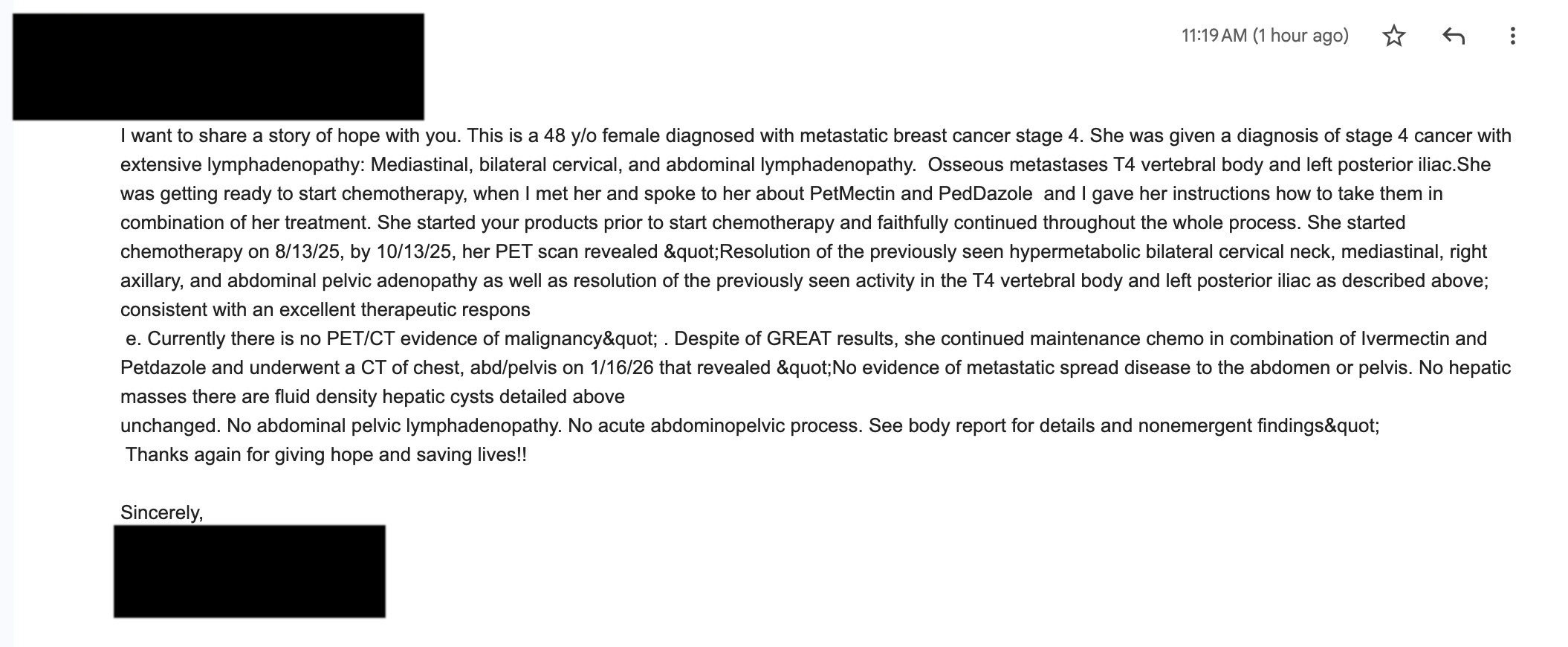
I want to share a story of hope with you. This is a 48 y/o female diagnosed with metastatic breast cancer stage 4. She was given a diagnosis of stage 4 cancer with extensive lymphadenopathy: Mediastinal, bilateral cervical, and abdominal lymphadenopathy. Osseous metastases T4 vertebral body and left posterior iliac.
She was getting ready to start chemotherapy, when I met her and spoke to her about IverX and FenbenX and I gave her instructions how to take them in combination of her treatment.
She started your products prior to start chemotherapy and faithfully continued throughout the whole process.
She started chemotherapy on 8/13/25, by 10/13/25, her PET scan revealed:
“Resolution of the previously seen hypermetabolic bilateral cervical neck, mediastinal, right axillary, and abdominal pelvic adenopathy as well as resolution of the previously seen activity in the T4 vertebral body and left posterior iliac as described above; consistent with an excellent therapeutic response. Currently there is no PET/CT evidence of malignancy.”
Despite of GREAT results, she continued maintenance chemo in combination of IverX and FenbenX and underwent a CT of chest, abd/pelvis on 1/16/26 that revealed:
“No evidence of metastatic spread disease to the abdomen or pelvis. No hepatic masses there are fluid density hepatic cysts detailed above unchanged. No abdominal pelvic lymphadenopathy. No acute abdominopelvic process. See body report for details and nonemergent finding.”
Thanks again for giving hope and saving lives!!
As written about previously, readers of this Substack know about several quality chemotherapy research studies that showed far superior outcomes when using Ivermectin in combination with chemo versus chemo alone — unsurprisingly, none of the researchers included an Ivermectin only group to compare against a chemotherapy only group for obvious reasons.
For example:
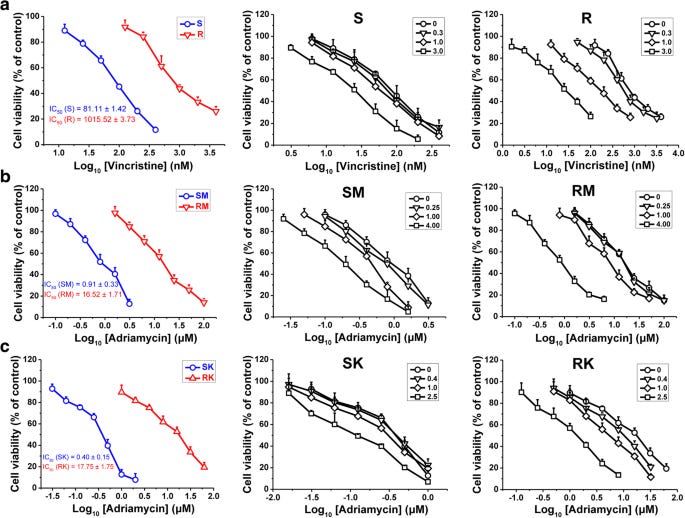
These findings demonstrated that ivermectin significantly enhanced the anti-cancer efficacy of chemotherapeutic drugs to tumor cells, especially in the drug-resistant cells. Thus, ivermectin, a FDA-approved antiparasitic drug, could potentially be used in combination with chemotherapeutic agents to treat cancers and in particular, the drug-resistant cancers.
Ivermectin increased the sensitivity of the cells to chemotherapeutic drugs. a-c The cell viability of sensitive or resistant HCT-8 cells (a), MCF-7 cells (b) and K562 cells (c) after treated with vincristine or adriamycin with or without different concentrations of ivermectin (IVM) for 48 h. Cell viability was determined by MTT assay. The numbers in the figure keys represent the concentrations (μM) of IVM. Cells treated with vehicle serve as a blank control. Abbreviations: IVM, ivermectin; S, vincristine-sensitive HCT-8 cells; R, vincristine-resistant HCT-8 cells; SM, adriamycin-sensitive MCF-7 cells; RM, adriamycin-resistant MCF-7 cells; SK, adriamycin-sensitive K562 cells; RK, adriamycin-resistant K562 cells. All experiments were conducted in quintuplicates and data were expressed as the mean ± SD (n = 5)
The authors concluded:
In summary, our study reveals that IVM increased the sensitivity of tumor cells, including the drug-sensitive or resistant cancer cells, solid tumor cells or leukemia cells, to the chemotherapeutic drugs. It is the first time to show that IVM could reverse multidrug resistance in vivo. Mechanistically, IVM directly interacts with the extracellular domain of EGFR, and reverses the drug resistance by inhibiting the EGFR/ERK/Akt/NF-κB pathway to downregulate the expression of P-gp. Therefore, we propose that IVM might be used clinically as a therapy to resolve the MDR problem, given that IVM has already been approved in human use.
Whether or not this oncology nurse practitioner knew about these Ivermectin and chemo research studies or not, one thing is absolutely certain: this oncology nurse practitioner unequivocally saved the patient’s life.
And this oncology nurse practitioner will now save many more lives because this intelligent and kind person will continue to share with patients the most comprehensive ‘holy grail’ cancer cure and prophylaxis in plain sight, that also heals asthma, prion-based diseases like Alzheimer’s, mood disorders, Parkinson’s, Lyme Disease, myocarditis, leukemia, Lupus, skin conditions, and various other “incurable” ailments, as well as the common cold and seasonal flu:
The Ultimate Disease Cure & Prophylaxis Protocol
Tocotrienol and Tocopherol forms (all 8) of Vitamin E (400-800mg per day, 7 days a week). A product called Gamma E by Life Extension or Perfect E are both great.
Bio-Available Curcumin (600mg per day, 2 pills per day 7 days a week). A product called Theracurmin HP by Integrative Therapeutics is bioavailable.
ImmunX immune support which also greatly increases the bioavailability of both FenbendazoleandHydroxychloroquine (2 capsules per day) —for prophylaxis 2 capsules per day
Removing sugars and carbohydrates (cancer food) from your diet and replacing table sugar with a zero glycemic index, zero calorie, keto friendly rare sugar like AlluX
Oncologists are closed minded? They are the only doctors that can prescribe drugs (chemo) that they dispense to the patient and directly profit from. Chemo adds an estimated $100,000 to their salaries. They profit from killing you slowly. Closed minds equals big bank accounts.



Good news!
Oncologists are closed minded? They are the only doctors that can prescribe drugs (chemo) that they dispense to the patient and directly profit from. Chemo adds an estimated $100,000 to their salaries. They profit from killing you slowly. Closed minds equals big bank accounts.