
The following is an important update to last week’s article…
BOMBSHELL: Study Involving 1.7 million Children Found Myocarditis & Pericarditis ONLY In PSYOP-19 mRNA "Vaccine" Recipients

All vaccines will kill you and your children, so it comes as little surprise that according to a 2024 research study titled, OpenSAFELY: Effectiveness of COVID-19 vaccination in children and adolescents, the Modified mRNA slow kill bioweapon platform is especially deadly.
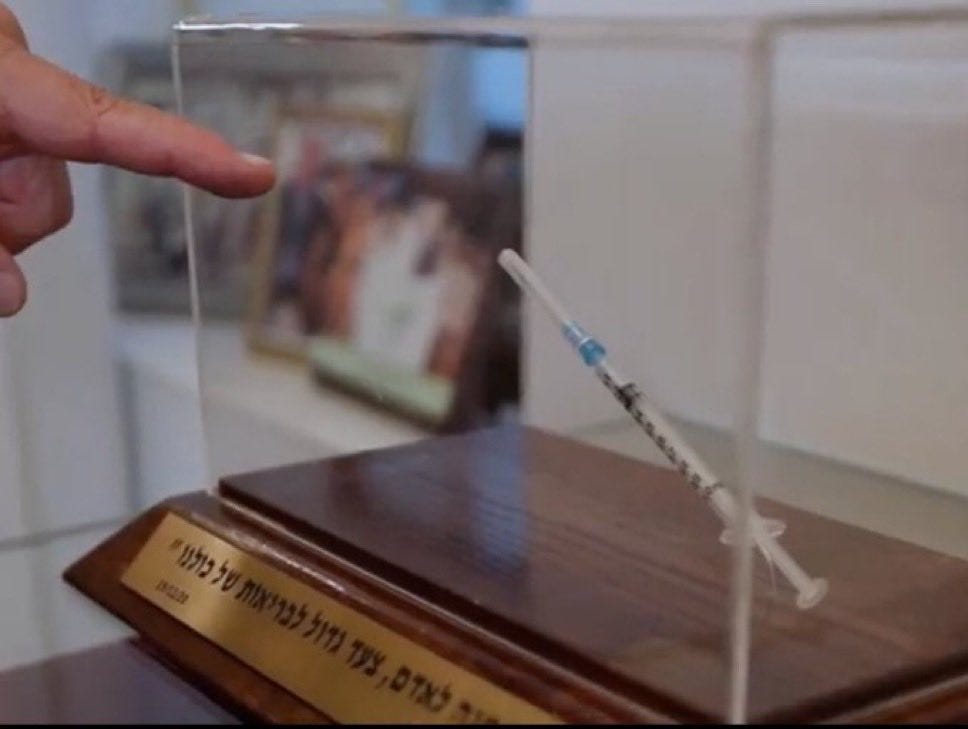
…with Israel’s innocent citizens being the ultimate Pfizer lab rats in BigPharma’s petri dish arrangement, courtesy of Israeli Prime Minister Netanyahu, with the deranged warmonger sociopath proudly displaying in his office the encased symbol of the bioweapon delivery system:
And now we have truly horrifying proof of just how bad the genetically altered Israel citizenry is faring after being poisoned by the PSYOP-19 Modified mRNA slow kill bioweapon “vaccines;” but there is hope to attenuate some of this damage, and cure other VAIDS-induced adverse events that will be shared at the end of this article…
271 Teenage Cardiac Reports Buried in a File Labeled “Garbage”
by Yaffa Shir-Raz, Yaakov Ophir
Two hundred and seventy-one. That is the number of serious cardiovascular events reported among adolescents in Israel’s national surveillance system in just a few weeks during mid-2021.
This is the core finding of our study, published this week in the International Journal of Cardiovascular Research & Innovation. Our analysis examined a dataset of 294,877 adverse event reports submitted by healthcare professionals within Clalit Health Services, Israel’s largest health organization, during the Covid-19 vaccination campaign. These reports were formally transferred to the Ministry of Health. In May 2024, the Israeli State Comptroller revealed that approximately 279,300 of those reports had not been processed by the Ministry. The dataset we analyzed consists of those very reports.
When we examined the file, the clustering was immediately visible. The structured fields alone revealed hundreds of cardiovascular cases. After applying deliberately conservative deduplication rules and excluding potential duplicate entries, 271 unique reports of cardiovascular events remained among adolescents aged 12 to 16. Nearly all occurred within a narrow window of just a few weeks, coinciding with the expansion of vaccine eligibility to this age group. Even under restrictive assumptions, this amounts to a minimum observed rate of approximately one cardiovascular event per 939 vaccinated adolescents.
In response to the Comptroller’s findings, the Ministry dismissed the dataset as flawed, citing missing fields and duplicate entries. The Head of Public Health Services publicly described the report as “garbage.” Yet the structure of the data allows straightforward filtering and analysis. Even with its limitations, the clustering is evident and required immediate examination.
This leaves only two possible conclusions. Either the reports reflected real clinical events, meaning a disproportionately large and temporally concentrated safety signal was present in the national system while the vaccination campaign for children was being expanded. Or, if the Ministry is correct and the file is indeed “garbage,” then the monitoring system itself was not functioning as publicly presented. If so, authorities were flying blind, promoting a product as “safe” while the very mechanism meant to monitor that safety was fundamentally broken.
Hidden in Plain Sight
The full picture that emerges from the file is presented below.
To ensure our findings rested on the most solid ground, we applied a deliberately conservative analytical strategy. We counted only unique reports in which key variables – sex, birth year, or dose number – were distinct. If there was any doubt about duplication or reliability, we excluded the report.
Despite this conservative approach, we identified 277 unique cardiovascular cases among minors, including acute cardiovascular injury, myocarditis, and pericarditis. The timing is impossible to ignore: 271 of these cases (98%) occurred among adolescents aged 12-16 within a narrow window of just a few weeks, temporally coinciding with the expansion of vaccine eligibility to this age group.
This pattern stands in direct contradiction to the risk profile presented to the public at the time. Official health authorities repeatedly described cardiac risks as “rare,” “mild,” and largely confined to young males following the second dose. The distribution observed in the dataset shows something different: cases were recorded across both sexes, across doses, and within a concentrated calendar window that coincided with the adolescent rollout.
The sheer scale of these reports is even more alarming when you look at the numbers. Approximately 254,000 Clalit-insured adolescents received at least one dose during that period. To derive a minimum risk estimate, we again leaned on the most restrictive assumptions possible, treating the 271 cases as the absolute total and ignoring potential underreporting. Even under these extreme constraints, the minimum observed rate was approximately one cardiovascular event per 939 vaccinated adolescents.
Passive surveillance systems are known to capture only a fraction of adverse events. Yet even without extrapolation, the rate observed in this dataset sits uneasily alongside what was publicly characterized as “rare.” Healthcare provider-submitted reports were present in the national surveillance system in real time, as eligibility expanded and public messaging emphasized that cardiac risks in adolescents were minimal.
How a Safety Signal Was Reframed as “Garbage”
When the State Comptroller’s report was published in May 2024, it revealed that approximately 96% of the adverse event reports transferred by Clalit between December 2020 and May 2022 had not been absorbed into the Ministry of Health’s monitoring systems.
Instead of prompting a substantive safety review, the findings triggered a dispute over data transfer. The Ministry maintained only 4% of the reports were usable, citing missing fields and duplicate entries. Clalit fired back, insisting everything had been sent “by the book.” In the crossfire, the debate centered on formatting and technical integration, while the substantive question remained unaddressed: what did the reports contain?
While the Ministry’s formal response to the Comptroller focused on these missing fields and technical gaps, Dr. Sharon Alroy-Preis, then the Head of Public Health Services, was much more blunt during a 2024 Knesset oversight hearing. She dismissed the reports, ignoring the fact that they were submitted by doctors and nurses, and even labeled them “garbage.” Moreover, she even claimed that “tens and thousands” of those reports were “false reports.”
But as our study demonstrates, the file was far from unreadable. It was filled with standardized codes and clear data from healthcare providers. The safety signal did not depend on the missing fields – it was visible within the structured data itself. By branding the data as “garbage,” officials shifted the institutional focus from examining the signal to disputing the medium through which it was transmitted.
How the Alarming Reports Were Buried
The Ministry of Health’s awareness of the cardiovascular risk dates back to the very beginning. On February 28, 2021, months before the adolescent rollout, the Ministry alerted the CDC to a “large number” of myocarditis cases in young people. This alert, later disclosed through a US Freedom of Information request, demonstrates that the emerging cardiovascular risk was recognized at a very early stage.
Yet, as the State Comptroller’s 2024 report revealed, the Ministry was also aware of significant reporting gaps at a very early stage, at least as early as February 2021. This leads to a central question: Why, despite knowing both the risk and the technical glitches, did the Ministry fail to analyze the actual content of nearly 300,000 reports to determine whether a safety signal was present?
Perhaps an even more fundamental question follows. Is it plausible that neither the health fund nor the Ministry conducted even a preliminary examination of the file, despite missing fields? Given the simplicity of the reporting structure, where identifying clustering requires little more than basic filtering, it is difficult to assume that no such elementary step was ever taken. Was the file truly never examined, or was it examined and its implications left unaddressed?
Rather than triggering a substantive examination of the reports themselves, the issue increasingly became framed as a technical and procedural dispute. The Ministry, Clalit, and even the State Comptroller focused largely on questions of data transfer, missing fields, and system integration. This institutional focus created an appearance of oversight, while the clinical content of the reports remained largely unexamined. The debate over format and functionality shifted attention away from what the dataset might reveal.
By the time the rollout for 12-15-year-olds began, the national surveillance file was already showing a concentrated cardiovascular pattern that mirrored the Ministry’s own earlier warning. By framing the issue primarily as a “technical malfunction,” the discussion moved away from the medical content of the reports themselves. The technical debate between the Ministry and Clalit functioned as a distraction, allowing an appearance of scrutiny while the alarming reports submitted by medical staff were effectively buried, and the public was reassured into complacency.
As Professor Retsef Levi, an expert in risk management and health analytics at MIT, explains: “Transparency on the benefits, risks and related uncertainty is key to build trust in vaccine programs, and is ethically required as part of informed consent. Unfortunately, during the COVID vaccination campaigns we have seen examples when these principles were not followed. I think that especially for populations with low risk for severe outcomes, health agencies should be very timely and proactive in analyzing potential safety risks and inform parents and patients about what is known and what is unknown “
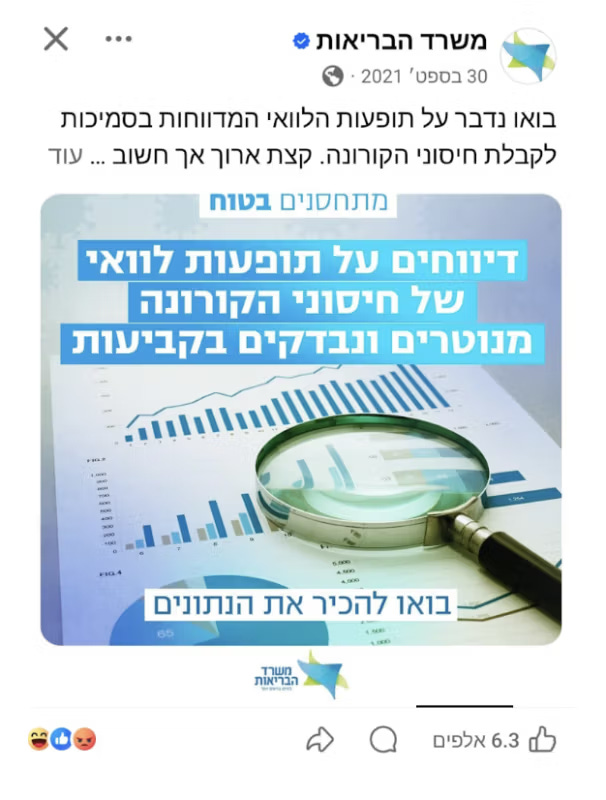
At the very same time, official public messaging projected confidence in continuous oversight. In a September 2021 communication, the Ministry of Health informed the public that adverse events were being routinely reviewed and examined by professional committees. Public statements during this period similarly emphasized that reported post-vaccination symptoms were generally temporary and not a cause for concern, reinforcing public confidence that safety oversight was functioning as intended.
The Israeli case was not unique. Internal CDC and FDA correspondence shows a similar dynamic following Israel’s early alert. In an internal response document (“Myocarditis Response.docx”), US officials reframed the warning as follows: “The Ministry of Health stated they received reports of around 40 cases of this adverse event. They did not provide additional details about these cases” (CDC, 2023, p. 714). FOIA disclosures further reveal that US officials reassured themselves by citing just 27 VAERS reports identified by late February 2021. Rather than prompting escalation, attention shifted toward the absence of technical detail, allowing uncertainty about reporting completeness to temper the perceived urgency of the signal itself.
This broader context matters because Israel was widely described at the time as the world’s “vaccine laboratory,” a characterization publicly echoed by Pfizer CEO Albert Bourla, who emphasized the country’s centralized health data as uniquely suited for real-time monitoring. As global health authorities looked to Israel for early safety insights, the consequences of an unexamined signal extended beyond national borders. Whether the reports were never analyzed or were analyzed without triggering regulatory action, the failure reverberated internationally.
Ultimately, the Ministry’s attempt to dismiss these records as “garbage” collapses under its own logic. If the reports are accurate, they point to a serious safety signal that was ignored. But if the Ministry is correct and the data is indeed “defective,” two disturbing questions remain: First, how did hundreds of unique cardiovascular reports among adolescents appear “out of thin air” within a monitoring system restricted solely to medical professionals, and second, why did the Ministry fail to correct the system in real time while aggressively encouraging parents to vaccinate children who were at no significant risk from the disease?
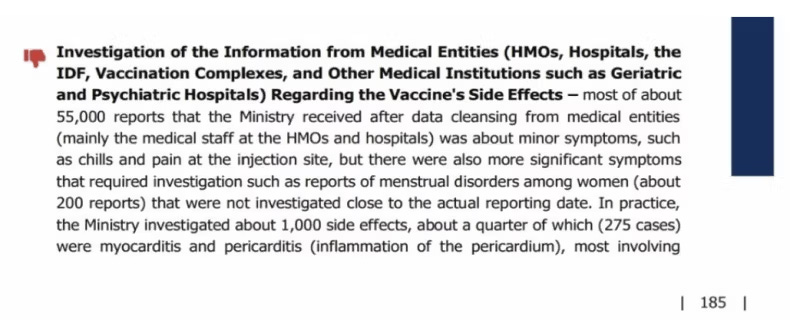
As the State Comptroller himself noted, while many reports received from medical institutions described minor symptoms, others involved “more significant symptoms that required investigation…[yet] were not investigated close to the actual reporting date.” In practice, the report adds, “the Ministry investigated about 1,000 side effects, about a quarter of which (275 cases) were myocarditis and pericarditis.” This finding reinforces the central concern raised by our analysis: that critical safety information submitted by healthcare professionals may not have been evaluated when it mattered most.
Moreover, if missing information was the only barrier to analysis, why has the Ministry not retrieved and examined it by now? The missing data still exists within Clalit’s systems. One year after the Comptroller’s report, co-author David Shuldman formally inquired whether the Ministry had completed such a review. The Ministry responded that it held no additional information and referred the inquiry back to Clalit.
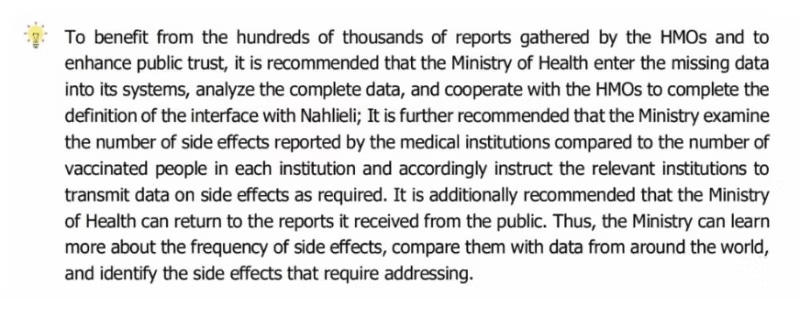
In his recommendations, the State Comptroller called on the Ministry of Health to “enter the missing data into its systems, analyze the complete data, and cooperate with the HMOs” so that the hundreds of thousands of reports collected by medical institutions could be fully utilized. The recommendation itself assumes that the information required for analysis remained available.
These are not just procedural questions. They concern the core function of regulatory oversight. The Ministry authorized the vaccine, expanded its use to children, and assured the public that safety was being monitored, even as it acknowledged significant failures in the monitoring system. If the transferred file was incomplete, that did not remove the Ministry’s obligation to complete the review.
Our analysis reveals an unusual and temporally concentrated cardiovascular signal among adolescents. Nearly five years later, the underlying reports remain unexplained. Until these findings are fully examined, serious concern remains that the vaccination campaign may have exposed children to risks that were not adequately evaluated at the time.
In the following article from three years ago, a myocarditis cure was proposed…
EXCLUSIVE RESEARCH BOMBSHELL: Possible Treatment Approach for Management of Post-COVID Vaccination Myocarditis

This is perhaps the most important article in this Substack’s ongoing series exposing the Modified mRNA slow kill bioweapon, and the various associated “vaccine”-induced death and disease mitigation strategies incorporating inexpensive repurposed drugs that actually work.
…with the following protocol specific to VAIDS-induced heart damage as follows:
The following compounds have been shown to have anti-inflammatory and anti-MMP properties, including doxycycline:
Ivermectin
Resveratrol
Zinc (2SG: using a powerful nutraceutical like VIR-X which has Zinc as one of its ingredients as well as Quercetin, which insures the Zinc penetrates the cells is optimal)
Tetracyclines (including doxycycline)
These compounds have demonstrated benefits in various preclinical models of disease, including myocarditis. For instance, ivermectin has been shown to reduce inflammation and improve heart function in a mouse model of viral myocarditis. Resveratrol has decreased MMP activity and enhanced heart function in a rat model of autoimmune myocarditis. Zinc has lowered inflammation and improved heart function in a rat model of doxorubicin-induced myocarditis. Tetracyclines, including doxycycline, have diminished MMP activity and improved heart function in a mouse model of pressure overload-induced myocarditis.
The combination of these compounds may represent a promising approach to the treatment of myocarditis. By concurrently addressing inflammation and MMP activity, these compounds may more effectively prevent heart muscle damage and facilitate healing.
Clinical trials are essential to assess the safety and efficacy of these compounds in myocarditis treatment. However, the preclinical data suggest that these compounds may serve as promising candidates for the development of new therapies for this condition.Conclusion:
The combination of anti-inflammatory and anti-MMP compounds, including , may hold potential as a therapy for myocarditis. These compounds have shown benefits in preclinical models of the disease and may be capable of preventing heart muscle damage and promoting healing more effectively. Clinical trials are warranted to evaluate the safety and effectiveness of these compounds
in the treatment of myocarditis.
Perhaps instead of bioterror coverups like these by criminal governments as found in Israel and America, the various “experts” could instead come clean and start saving lives by sharing protocols such as the following, which would be optimal for heart damage, as well as representing not only the ‘holy grail’ (turbo) cancer cure in plain sight, but also possibly treating “vaccine” shedding exposure, Alzheimer’s, mood disorders, Parkinson’s, Lyme Disease, Hashimoto’s Disease, leukemia, Lupus, skin conditions, and various other “incurable” ailments, as well as the common cold and seasonal flu:
The Ultimate Disease Cure & Prophylaxis Protocol
Tocotrienol and Tocopherol forms (all 8) of Vitamin E (400-800mg per day, 7 days a week). A product called Gamma E by Life Extension or Perfect E are both great.
Bio-Available Curcumin (600mg per day, 2 pills per day 7 days a week). A product called Theracurmin HP by Integrative Therapeutics is bioavailable.
Vitamin D (62.5 mcg [2500 IU] seven days a week).
CBD oil (1-2 droppers full [equal to 167 to 334 mg per day] under the tongue, 7 days a week) CBD-X: The most potent full spectrum organic CBD oil, with 5,000 milligrams of activated cannabinoids and hemp compounds CBD, CBN & CBG per serving.
Fenbendazole (450mg, 7 days a week) or in the case of severe turbo cancers up to 1 gram — for prophylaxis one 150mg tablet once or twice per week
Ivermectin (24mg, 7 days a week) or in the case of severe turbo cancers up to 1mg/kg/day — for prophylaxis one 12mg tablet once or twice per week
Hydroxychloroquine (10mg/kg/day 7 days a week) - for prophylaxis one 200mg tablet once or twice per week
Doxycycline (100mg, 7 days a week for 30-60 days)
ImmunX immune support which also greatly increases the bioavailability of both Fenbendazole and Hydroxychloroquine (2 capsules per day) — for prophylaxis 2 capsules per day
Removing sugars and carbohydrates (cancer food) from your diet and replacing table sugar with a zero glycemic index, zero calorie, keto friendly rare sugar like AlluX
Do NOT comply.


Demonic.
My friend's brother worked at Phizzer and got my friend in at Phizzer in NYC for his jabs.
Curious if those shots were cleaner or they were just as lab-ratted.
My CT Phizzer roommate, whose daughter was heavily jab-damaged, insisted on getting jabbed (plus the immuno-compromised kids) ASAP.
Will they ever see the light? And I don't mean the light at the end of the tunnel after death, just to be clear.
The evidence continues to mount. I found out about vaccines decades ago. Thank God. It's hard to go against this corrupt system for parents, but their kids lives depend on them having the courage to do so.