
The following is an important article highlighting Fenbendazole and Ivermectin mechanisms of action, and at the conclusion will be featured the most cutting edge ‘holy grail’ cancer cure protocol…
by Ben Fen
Fenbendazole Can Cure Cancer presents Case Reports of people who have treated their own cancers along with other articles to help understand how fenbendazole works to treat cancer. Previous articles covering other cancers are in the Archives link. This Substack is one of several sources that aggregate Case Reports from those that are self-treating their cancers with repurposed antiparasitics including fenbendazole, mebendazole and ivermectin. This article is the first in a series that will synthesize these Case Reports looking for guiding signals in the data and reports. The sources of these Case Report data are Fenbendazole Can Cure Cancer, OneDayMD, Dr. William Makis, and various Social Media Fenbendazole Groups.
The Worst Diagnosis in Oncology
Pancreatic ductal adenocarcinoma (PDAC) is what oncologists use when they want to explain hopelessness. Over 90% of cases carry activating mutations in KRAS — the master driver oncogene that no approved targeted therapy has successfully dismantled for the general PDAC population. The disease is almost always diagnosed late. Surgery is possible in fewer than 20% of patients. FOLFIRINOX — the most aggressive chemotherapy regimen in common use — extends median survival by a few months against gemcitabine alone. Five-year survival for Stage 4 disease: approximately 3%.
These are the numbers your oncologist will cite when they tell you to get your affairs in order. What they will not cite are the 49 documented cases — from New Zealand to New York, from Kentucky to Romania — in which patients given weeks to live are alive years later. In which tumors dismissed as untreatable have collapsed under protocols built on antiparasitic drugs that cost less than a daily cup of coffee.
This article is that record. Read it. Share it. And if you are facing this diagnosis, understand that the biological problem is solvable — even if the institutional problem is not.
Key Numbers:
49 — Documented pancreatic cancer cases using antiparasitic protocols (2022–2026)
93% — Maximum pancreatic tumor shrinkage recorded (Case No. 33)
99.9% — CA19-9 drop recorded (Case No. 9: from 44,960 to 21)
The Mechanism: Why Antiparasitics Hit PDAC Hard
The foundational argument of my book — Cancer Is a Parasite — is that cancer shares deep biological architecture with parasitic organisms. Nowhere is this convergence more therapeutically relevant than in PDAC. The vulnerabilities that parasites share with pancreatic cancer cells are precisely the vulnerabilities that benzimidazoles and ivermectin have been exploiting for decades in veterinary and human medicine.
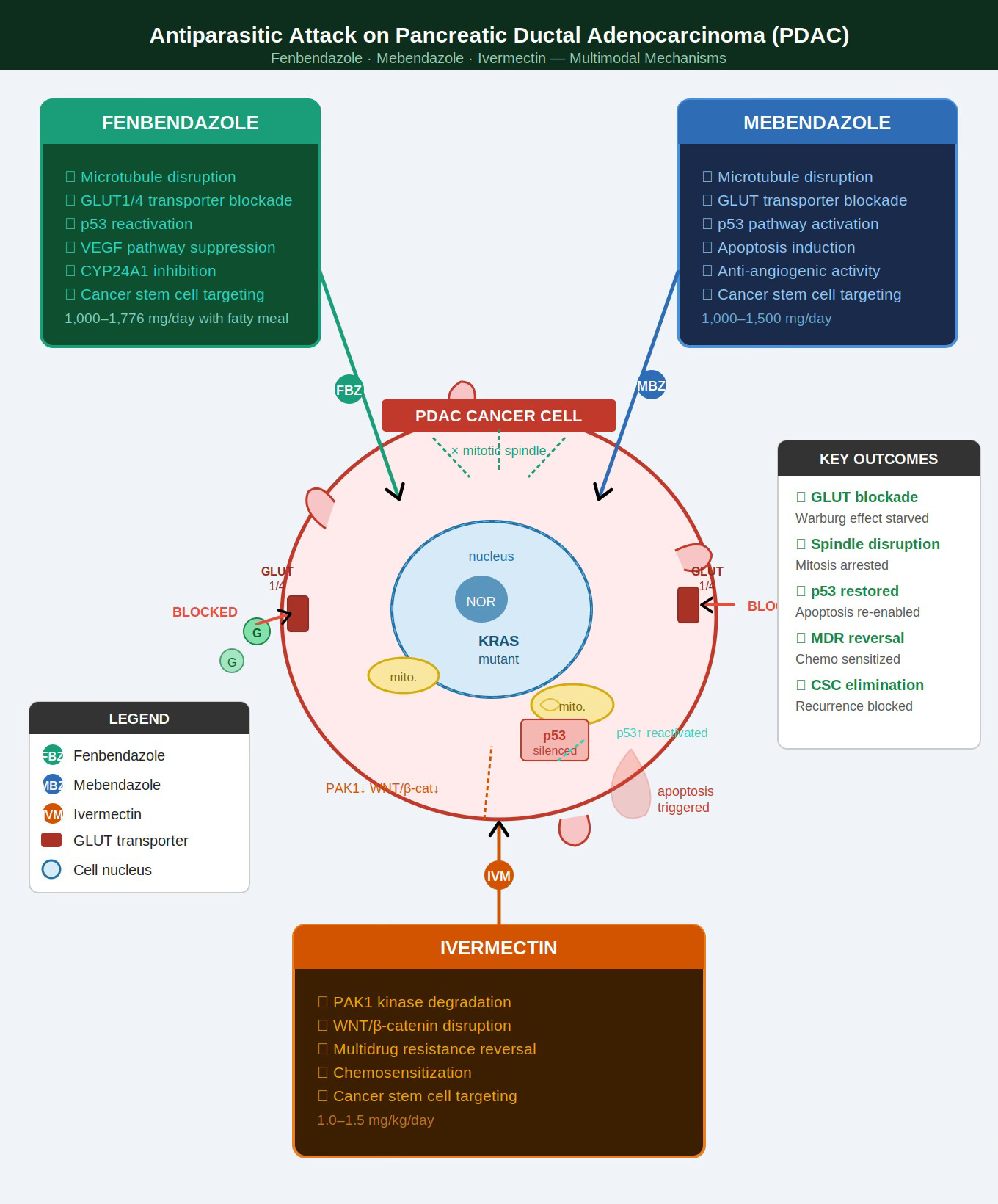
Fenbendazole (FBZ) and Mebendazole (MBZ) — Eight Anticancer Mechanisms:
Microtubule Disruption. FBZ binds β-tubulin with high affinity, depolymerizing the mitotic spindle. Cancer cells in rapid division cannot complete mitosis. Cell death follows.
Warburg Effect Blockade. GLUT1 and GLUT4 glucose transporter suppression starves PDAC’s glycolytic dependency. KRAS-driven tumors are extraordinarily glycolytic — cut the glucose, cut the fuel.
p53 Reactivation. FBZ stabilizes and upregulates p53 — the tumor suppressor that PDAC has silenced or mutated. Restored p53 function triggers apoptosis in tumor cells.
Cancer Stem Cell Elimination. Both FBZ and IVM target cancer stem cells — the self-renewing subpopulation responsible for recurrence and chemoresistance that conventional chemotherapy misses entirely.
Multidrug Resistance Reversal. IVM inhibits NF-κB pathway activation and efflux pump overexpression — the primary mechanisms driving PDAC’s notorious resistance to consecutive chemotherapy regimens.
CYP24A1 Inhibition. FBZ blocks CYP24A1 — the enzyme tumors upregulate to destroy local vitamin D (Supple, 2026). Restored vitamin D activity re-enables immune surveillance that PDAC has suppressed.
VEGF Pathway Suppression. FBZ reduces vascular endothelial growth factor signaling — cutting off tumor angiogenesis and, in several cases, contributing to resolution of malignant ascites.
Chemosensitization. IVM reverses tumor resistance to concurrent chemotherapy. Cases consistently show: modest chemo response alone, then dramatic collapse once IVM is added. The mechanism is real and documented.
This is not one mechanism. It is eight — against a cancer that defeats single-pathway therapies by evolving around them. As explained in Cancer is a Parasite, the multimodal logic of antiparasitic treatment is precisely why the case series below shows responses that oncologists call miraculous. It is not a miracle. It is mechanism operating on multiple axes simultaneously.
The Cases: A Global Signal
The Chemosensitization Proof-of-Concept
The most scientifically powerful cases are those that isolate the contribution of antiparasitics by providing a direct before-and-after comparison. Case 33 is the archetype.
—
Case No. 33 · France · December 2025
54-Year-Old Man — Stage 4 Pancreatic Cancer Metastatic to Liver
Five cycles of FOLFIRINOX produced only a 17% tumor burden reduction — classified as non-significant by RECIST criteria. The patient then added ivermectin (1 mg/kg/day) and mebendazole (1,500 mg/day) to ongoing chemotherapy.
Results over the next five identical chemo cycles:
Pancreatic primary: 32 mm → 13 mm (93.3% volume reduction)
Liver Seg 7/8 lesion: 58 mm → 45 mm (53.3% volume reduction)
Liver Seg 7 lesion: 18 mm → 8 mm (91.2% volume reduction)
Retroperitoneal lymph node: 11 mm → 7 mm (74.2% volume reduction)
Same chemo. Same patient. The only variable was the antiparasitics. Chemo alone = 17% reduction over 5 cycles. Chemo + IVM + MBZ = up to 93% reduction over 5 cycles. This potentiation effect is consistent across most solid tumor cancers as detailed in Cancer is a Parasite.
—
Case No. 40 · Canada · April 2026
56-Year-Old Man — Stage 4 Pancreatic Cancer
Started ivermectin and fenbendazole alongside chemotherapy in September 2025. Six-month results:
Pancreatic mass: 40×32 mm → 17×23 mm (78% volume reduction)
Liver lesions: 55% volume reduction
CA19-9: 2,784 → 37
His oncologist remarked, “Cancer patients almost never see dramatic results like this with chemo alone. This is treatment synergy.”
—
Case No. 39 · Romania · March 2026
75-Year-Old Man — Stage 4 Pancreatic Cancer
Triple therapy — ivermectin + fenbendazole + mebendazole — alongside chemotherapy, started November 2025. Five-month results:
CA19-9: 18,630 → 1,000 (95% drop)
Pancreatic mass: 45×35 mm → 22×14 mm (92% volume shrinkage)
No Evidence of Disease — The NED Cases
Several patients achieved complete radiologic clearance — No Evidence of Disease — in a cancer where that outcome is not supposed to exist.
—
Case No. 41 · New Zealand · May 2026
70-Year-Old Man — Stage 4 Pancreatic Cancer · Given 2–3 Months to Live
Diagnosed with Stage 4 disease and given a two-to-three-month prognosis. Declined all conventional oncology. In May 2025, began ivermectin, fenbendazole, and hyperbaric oxygen therapy (HBOT).
Twelve months later: No Evidence of Disease. No chemotherapy. No radiation. No traditional oncology treatment of any kind.
—
Case No. 35 · Argentina / Quebec · January 2026
43-Year-Old Woman — Unresectable 5 cm Pancreatic Mass
Presented with a 5 cm pancreatic tail mass confirmed non-resectable by surgery in Canada. For 11 months: ivermectin (72 mg/day), fenbendazole (1,500 mg/day), mebendazole (1,500 mg/day in the final month).
CT scan with contrast at 11 months: “Pancreas appears normal with no anomalies.”
Her Argentine oncologist — in contrast to his Canadian colleagues — requested a copy of the protocol to apply to other patients.
—
Case No. 24 · Pennsylvania, USA · October 2025
53-Year-Old Man — Stage 4 Pancreatic Cancer
Started IVM (1.5 mg/kg/day), FBZ (1,500 mg/day), and chemotherapy in late March 2025. Six-month results:
PET scan: no evidence of metabolically active disease
Liver metastases: completely resolved
CA19-9: 154 → 17
His oncology team repeatedly told him the disease “would come back,” characterized his recovery as “no longer a curative discussion,” and attempted to dissuade him from ordering the confirmatory PET/CT that proved his NED status.
—
Case No. 17 · Maryland, USA · June 2025
67-Year-Old Woman — Stage 4 After Failed FOLFIRINOX
Three months of neoadjuvant FOLFIRINOX: no improvement, suspected Stage 4 progression with new liver metastases. She started IVM (1.5 mg/kg/day), FBZ (1,000 mg/day), and CBD oil in early March 2025.
CT at 2.5 months:
Pancreatic head mass: “no longer visualized”
Liver nodules: absent
CA19-9: 942 → 9
Complete radiologic clearance in a patient who had already failed FOLFIRINOX entirely.
The Standout Data Points
Case No. 9 · age 77, male 2025
Stage 4 Pancreatic Cancer Patient
Protocol: Mebendazole 1,000 mg (morning) + Fenbendazole 888 mg (afternoon). No ivermectin. No chemotherapy.
Results:
CA19-9: 44,960 → 21 (99.9% reduction)
Large liver lesion: 70% volume reduction
Second liver lesion: 87% volume reduction
“I do not remember a person with results like this.” — His oncologist, after 35 years in practice. He called the results a miracle.
It was not a miracle. It was fenbendazole and mebendazole operating on a cancer that had no defense against their mechanisms.
—
Case No. 20 · Stage 4 pancreatic cancer. The Canadian MAID Case · 2025
A Canadian patient with Stage 4 pancreatic cancer recurrence — with lung metastases — was offered Medical Assistance in Dying (MAID) as the primary clinical recommendation.
He started fenbendazole (444 mg/day, escalating), then added ivermectin.
Result: “The CT scan showed that all signs of cancer were undetectable and essentially resolved.”
His primary oncologist was shocked by the turnaround. The patient avoided Canada’s first clinical offer — euthanasia — through a drug that costs less than a cup of coffee per dose.
What the Oncologists Said
The tumor responses documented above are extraordinary. But arguably more revealing is the institutional reaction — a pattern that repeats across nearly every case in this series.
Case No. 34 (Kentucky): The oncologist told the patient her tumor would not shrink. It shrank 82%.
Case No. 26 (Florida): A tumor shrank 56% in volume on ivermectin and fenbendazole alone, after the patient abandoned FOLFIRINOX. Official chart notation: “stable disease.”
Case No. 12 (California): When the Stanford oncologist saw the results — 81% CA19-9 drop and 46% reduction in PET metabolic activity — she was reportedly “not happy” that her patient was taking fenbendazole and ivermectin.
Case No. 24 (Pennsylvania): PET-confirmed NED. The oncology team told the patient the disease “would come back” and attempted to prevent him from ordering the confirmatory scan that documented his remission.
Case No. 9: CA19-9 dropped from 44,960 to 21. His oncologist’s response after 35 years in practice: he called it a miracle. The only oncologist in this series honest enough to admit he had no framework for what he was seeing.
Pattern Recognition: Across 49 cases, the institutional response to antiparasitic-driven remission follows a consistent sequence: (1) dismissal of the protocol, (2) minimization of the response (”stable disease”), (3) attribution of any improvement to concurrent chemotherapy, (4) warnings that the disease “will come back,” and (5) in extreme cases, active discouragement of confirmatory imaging. This is not a bug in the oncology system. It is a feature of a system whose financial architecture is incompatible with $1-per-dose treatments.
Fenbendazole vs. Mebendazole: Which Wins for Pancreatic Cancer?
Both are benzimidazoles. Both share the core mechanism of β-tubulin binding and GLUT transporter suppression. The Italian head-to-head comparison (Florio et al., Cancers 2019) gives fenbendazole a slight edge for pancreatic cancer specifically.
Mebendazole is FDA-approved for human use — easier to obtain via prescription
[2SG: Fenbendazole is far more superior:
Fenbendazole Is The Superior Anticancer Agent Versus Mebendazole
·
For many years now this Substack has specified in passing that Fenbendazole was superior to Mebendazole in terms of bioavailability and efficacy for most applications, but in yesterday’s article…
Fenbendazole is lower cost (~$1/dose) and available OTC for veterinary use
Both are fully interchangeable when one is unavailable
Case No. 9 (CA19-9: 44,960 → 21) used mebendazole + fenbendazole, no ivermectin
Case No. 27 (Michigan, 50% tumor shrinkage) used mebendazole alone

Bottom line: Get whichever you can access. Both work. The combination is stronger than either alone. For pancreatic cancer specifically, the published comparative data favors fenbendazole — but mebendazole has produced landmark results on its own.
The Signal Is Too Large to Dismiss
Forty-nine cases. Fourteen countries. Ages 33 to 78. Stages 2 through 4. Chemo-naive patients, multiple chemo-refractory patients, post-Whipple recurrences, patients given two months to live. The responses are not scattered noise — they cluster around a consistent biological signal: benzimidazoles and ivermectin are active against PDAC, and their activity is amplified by chemotherapy synergy.
The methodological caveats are real: these are anecdotal cases, subject to reporting bias and confounding from concurrent therapies. These are also the identical caveats used to suppress every important medical advance before randomized trial evidence catches up to clinical reality.
The question is not whether these 49 cases constitute proof in the RCT sense. They do not. The question is whether 49 globally distributed cases — producing biologically coherent, mechanistically explicable responses across diverse patient populations — constitute sufficient signal to demand clinical investigation. They do. Unambiguously.
What To Do With This Information
You have options your oncologist will likely not present. Not because they are dangerous — benzimidazoles have a 50-year mass drug administration safety record — but because they fall outside the institutional training and incentive structure of modern oncology.
Pancreatic cancer patients can not wait for Phase III evidence. With a median Stage 4 survival of three to six months, you do not have the time that randomized trials require. The cases reviewed here are the evidence available now. Waiting for clinical trials to prove that a $1/dose drug is effective for pancreatic cancer is a fool’s errand.
Document everything. CA19-9 levels, imaging reports, protocol details, timeline. These case reports exist because patients and families documented what they did. Case No. 50 and beyond should be yours.
Invoke Right to Try. US legislation exists precisely for this situation. There are physicians around the world that operate telehealth practices offering integrative oncology consultation for patients seeking antiparasitic protocols, search under holistic, functional or integrative medicine specialities. (Maybe it is a good idea to start a database of these physicians for your quick access😉). There appears to be no reason against most of those suffering with pancreatic cancer to add antiparasitic therapy to their treatment protocol; either under the guidance of their doctor or as a self-treatment effort.
Read the science. Cancer is a Parasite: Kill It with the Safe, Over-the-Counter Antiparasitic Fenbendazole (Skyhorse/MAHA Books, 2026). The material in the book and the reference list there will arm you for every conversation you may, or may not choose to have with your oncologist.
Thankfully, readers of this Substack have known for many years that there is in fact a ‘holy grail’ cancer cure in plain sight that may also treat Alzheimer’s, mood disorders, Parkinson’s, Lyme Disease, myocarditis, Hashimoto’s Disease, shingles (herpes), leukemia, Lupus, skin conditions, various other “incurable” ailments and VAIDS adverse events, as well as gain-of-function viral releases, “vaccine” shedding, seasonal flu and even the common cold:
The Ultimate Disease Cure & Prophylaxis Protocol
Tocotrienol and Tocopherol forms (all 8) of Vitamin E (400-800mg per day, 7 days a week). A product called Gamma E by Life Extension or Perfect E are both great.
Bio-Available Curcumin (600mg per day, 2 pills per day 7 days a week). A product called Theracurmin HP by Integrative Therapeutics is bioavailable.
Vitamin D (62.5 mcg [2500 IU] seven days a week).
CBD oil (1-2 droppers full [equal to 167 to 334 mg per day] under the tongue, 7 days a week) CBD-X: The most potent full spectrum organic CBD oil, with 5,000 milligrams of activated cannabinoids and hemp compounds CBD, CBN & CBG per serving.
Fenbendazole (450mg, 7 days a week) or in the case of severe turbo cancers up to 1 gram — for prophylaxis one 150mg tablet once or twice per week
Ivermectin (24mg, 7 days a week) or in the case of severe turbo cancers up to 1mg/kg/day — for prophylaxis one 12mg tablet once or twice per week
Hydroxychloroquine (10mg/kg/day 7 days a week) - for prophylaxis one 200mg tablet once or twice per week
Doxycycline (100mg, 7 days a week for 30-60 days)
ImmunX immune support which also greatly increases the bioavailability of both Fenbendazole and Hydroxychloroquine (2 capsules per day) — for prophylaxis 2 capsules per day
Removing sugars and carbohydrates (cancer food) from your diet and replacing table sugar with a zero glycemic index, zero calorie, keto friendly rare sugar like AlluX
Do NOT comply.
Stay tuned for exciting new product launches from RESOLVX HEALTH, which will be coming very soon!
In the meantime, please take advantage of ⚡️THE MASSIVE FLASH SALE ⚡️by using code CREAM25 for 25% of on ALL of the amazing lifesaving products like the Nobel Prize winning miracle compound Ivermectin, the new release Ivermectin Cream, the no less miraculous Fenbendazole, Hydroxychloroquine, Doxycycline, the full spectrum organic CBD oil containing 5,000 milligrams of activated cannabinoids and hemp compounds CBD, CBN & CBG, the powerful immune support nutraceutical and spike support formula ImmunX, and the sugar craving reducing, blood sugar balancing and even anti-cancer allulose sugar substitute AlluX!
⚡️THE MASSIVE FLASH SALE ⚡️ ends Sunday, May 17th (midnight eastern time), 2026.
Upon adding products to your cart, please go to the cart icon at the top right corner of your browser page and click it, then choose the VIEW CART option whereby you will be redirected to a page where you can enter the code CREAM25 in the Use Coupon Code field.
Only the RESOLVX HEALTH website offers all of the authentic products that this Substack promotes.
Please contact the company directly with any product questions: info@resolvx.health


References
Epidemiology, Prognosis & Clinical Context
Conroy, T., Desseigne, F., Ychou, M., Bouché, O., Guimbaud, R., Bécouarn, Y., Adenis, A., Raoul, J.-L., Gourgou-Bourgade, S., de la Fouchardière, C., Bennouna, J., Bachet, J.-B., Khemissa-Akouz, F., Péré-Vergé, D., Delbaldo, C., Assenat, E., Chauffert, B., Michel, P., Montoto-Grillot, C., & Ducreux, M. (2011). FOLFIRINOX versus gemcitabine for metastatic pancreatic cancer. New England Journal of Medicine, 364(19), 1817–1825. https://doi.org/10.1056/NEJMoa1011923 [FOLFIRINOX median OS 11.1 months vs gemcitabine 6.8 months]
Conroy, T., Hammel, P., Hebbar, M., Ben Abdelghani, M., Wei, A. C., Raoul, J.-L., Choné, L., Francois, E., Artru, P., Biagi, J. J., Lecomte, T., Assenat, E., Faroux, R., Ychou, M., Bauguion, L., Bellera, C., Bonastre, J., Ducreux, M., & PRODIGE 24/CCTG PA.6 Trial investigators. (2018). FOLFIRINOX or gemcitabine as adjuvant therapy for pancreatic cancer. New England Journal of Medicine, 379(25), 2395–2406. https://doi.org/10.1056/NEJMoa1809775 [Modified FOLFIRINOX adjuvant; extended DFS over gemcitabine]
National Cancer Institute, Surveillance, Epidemiology, and End Results Program. (2024). Cancer stat facts: Pancreatic cancer. SEER Cancer Statistics. [https://seer.cancer.gov/statfacts/html/pancreas.html — Stage IV 5-year survival 3%]
Rawla, P., Sunkara, T., & Gaduputi, V. (2019). Epidemiology of pancreatic cancer: Global trends, etiology and risk factors. World Journal of Oncology, 10(1), 10–27. https://doi.org/10.14740/wjon1166 [PDAC epidemiology; late-stage diagnosis; surgical eligibility <20%]
Vyas, M., Larson, A. C., Gopalakrishnan, V., & Bhatt, A. P. (2024). The clinical implications of KRAS mutations and variant allele frequencies in pancreatic ductal adenocarcinoma. Journal of Clinical Medicine, 13(7), 2103.https://doi.org/10.3390/jcm13072103 [KRAS mutated in >90% of PDAC; surgical eligibility <20%]
Williamson, T., de Abreu, M. C., Trembath, D. G., Brayton, C., Kang, B., Mendes, T. B., de Assumpção, P. P., Cerutti, J. M., & Riggins, G. J. (2021). Mebendazole disrupts stromal desmoplasia and tumorigenesis in two models of pancreatic cancer. Oncotarget, 12(14), 1326–1338. https://doi.org/10.18632/oncotarget.28014 [5-year survival metastatic PDAC 3%; MBZ in KPC/KC mouse models]
Fenbendazole: Anticancer Mechanisms
Dogra, N., Kumar, A., & Mukhopadhyay, T. (2018). Fenbendazole acts as a moderate microtubule destabilizing agent and causes cancer cell death by modulating multiple cellular pathways. Scientific Reports, 8(1), 11926. https://doi.org/10.1038/s41598-018-30158-6[β-tubulin binding; GLUT4/HKII downregulation; p53 activation; GLUT1 suppression]
Kim, S.-I., Kim, H.-J., Lee, H.-J., Lee, K., Hong, D., Lim, H., & Kim, S. (2023). Anti-cancer effect of fenbendazole-incorporated PLGA nanoparticles in ovarian cancer. Journal of Gynecologic Oncology, 34(5), e58. https://doi.org/10.3802/jgo.2023.34.e58 [FBZ VEGF downregulation; peritoneal tumor growth and ascites inhibition]
Park, Y. H., Choi, J. W., Lim, H. Y., Park, J. H., Kim, J. Y., Lee, J. H., & Kim, S.-T. (2024). Oral fenbendazole for cancer therapy in humans and animals. Anticancer Research, 44(9), 3725–3737. https://doi.org/10.21873/anticanres.17167 [FBZ mechanism review: microtubule, GLUT1, p53, anti-angiogenesis; safety record]
Song, B., Park, E.-Y., Kim, K. J., & Ki, S. H. (2022). Repurposing of benzimidazole anthelmintic drugs as cancer therapeutics. Cancers, 14(19), 4601. https://doi.org/10.3390/cancers14194601 [Benzimidazole class comprehensive review: FBZ, MBZ mechanisms across cancer types]
Mebendazole: Anticancer Mechanisms and PDAC Activity
Florio, R., Veschi, S., di Giacomo, V., Pagotto, S., Carradori, S., Verginelli, F., Cirilli, R., Casulli, A., Grassadonia, A., Tinari, N., & Cama, A. (2019). The benzimidazole-based anthelmintic parbendazole: A repurposed drug candidate that synergizes with gemcitabine in pancreatic cancer. Cancers, 11(12), 2042. https://doi.org/10.3390/cancers11122042 [Comparative benzimidazole screening in PDAC cell lines; FBZ and MBZ antiproliferative activity]
Limbu, K. R., Chhetri, R. B., Oh, Y.-S., Baek, D.-J., & Park, E.-Y. (2022). Mebendazole impedes the proliferation and migration of pancreatic cancer cells through SK1 inhibition dependent pathway. Molecules, 27(23), 8127.https://doi.org/10.3390/molecules27238127 [MBZ inhibition of PDAC cell proliferation and migration]
Rottenberg, S., Disler, C., & Arriola, P. (2021). The rediscovery of mebendazole as a targeted therapy. Trends in Cancer, 7(6), 527–540.https://doi.org/10.1016/j.trecan.2020.12.010 [MBZ mechanism; microtubule; p53; CSC; repurposing rationale]
Williamson, T., de Abreu, M. C., Trembath, D. G., Brayton, C., Kang, B., Mendes, T. B., de Assumpção, P. P., Cerutti, J. M., & Riggins, G. J. (2021). Mebendazole disrupts stromal desmoplasia and tumorigenesis in two models of pancreatic cancer. Oncotarget, 12(14), 1326–1338. https://doi.org/10.18632/oncotarget.28014 [MBZ reduces PanIN formation, desmoplasia, liver metastasis in KRAS-driven PDAC mouse models]
Ivermectin: Anticancer Mechanisms
Dominguez-Gomez, G., Chavez-Blanco, A., Medina-Franco, J. L., Saldivar-Gonzalez, F., Flores-Torrontegui, Y., Juarez, M., Díaz-Chávez, J., Gonzalez-Fierro, A., & Duenas-Gonzalez, A. (2018). Ivermectin as an inhibitor of cancer stem-like cells. Molecular Medicine Reports, 17(2), 3397–3403. https://doi.org/10.3892/mmr.2017.8231 [IVM preferentially inhibits CD44+/CD24− cancer stem cell subpopulation]
Dou, Q., Chen, H.-N., Wang, K., Yuan, K., Lei, Y., Li, K., Lan, J., Chen, Y., Huang, Z., Xie, N., Zhang, L., Xiang, R., Nice, E. C., Wei, Y., & Huang, C. (2016). Ivermectin induces cytostatic autophagy by blocking the PAK1/Akt axis in breast cancer. Cancer Research, 76(15), 4457–4469. https://doi.org/10.1158/0008-5472.CAN-15-2887 [PAK1 ubiquitination-mediated degradation; Akt/mTOR blockade; in vivo tumor suppression]
Jiang, L., Wang, P., Sun, Y.-J., & Wu, Y.-J. (2019). Ivermectin reverses the drug resistance in cancer cells through EGFR/ERK/Akt/NF-κB pathway. Journal of Experimental & Clinical Cancer Research, 38(1), 265. https://doi.org/10.1186/s13046-019-1251-7 [IVM reversal of multidrug resistance; NF-κB pathway inhibition; chemosensitization]
Liu, J., Zhang, K., Cheng, L., Zhu, H., & Xu, T. (2020). Progress in understanding the molecular mechanisms underlying the antitumour effects of ivermectin. Drug Design, Development and Therapy, 14, 285–296. https://doi.org/10.2147/DDDT.S237393 [IVM: PAK1, WNT-TCF, Hippo, Akt/mTOR, CSC inhibition, MDR reversal — mechanism review]
Tang, M., Hu, X., Wang, Y., Yao, X., Zhang, W., Yu, C., Cheng, F., Li, J., & Fang, Q. (2021). Ivermectin, a potential anticancer drug derived from an antiparasitic drug. Pharmacological Research, 163, 105207. https://doi.org/10.1016/j.phrs.2020.105207[Comprehensive IVM anticancer review: PAK1, WNT/β-catenin, apoptosis, CSC, MDR reversal]
Wang, K., Gao, W., Dou, Q., Chen, H., Li, Q., Nice, E. C., & Huang, C. (2016). Ivermectin induces PAK1-mediated cytostatic autophagy in breast cancer. Autophagy, 12(12), 2498–2499. https://doi.org/10.1080/15548627.2016.1231494 [Companion to Dou et al. 2016; PAK1-AKT-MTOR axis mechanistic detail]
CYP24A1 Inhibition and Vitamin D Biology
Christakos, S., Dhawan, P., Verstuyf, A., Verlinden, L., & Carmeliet, G. (2016). Vitamin D: Metabolism, molecular mechanism of action, and pleiotropic effects. Physiological Reviews, 96(1), 365–408. https://doi.org/10.1152/physrev.00014.2015 [Vitamin D catabolism; CYP24A1 as primary degrading enzyme; anti-tumor functions of 1,25D3]
Luo, W., Karpf, A. R., Deeb, K. K., Muindi, J. R., Morrison, C. D., Johnson, C. S., & Trump, D. L. (2010). Epigenetic regulation of vitamin D 24-hydroxylase/CYP24A1 in human prostate cancer. Cancer Research, 70(14), 5953–5962. https://doi.org/10.1158/0008-5472.CAN-10-0617 [CYP24A1 upregulation in tumors; suppression of vitamin D signaling in cancer]
Schuster, I. (2011). Cytochromes P450 are essential players in the vitamin D signaling system. Biochimica et Biophysica Acta, 1814(1), 186–199. https://doi.org/10.1016/j.bbapap.2010.06.022 [CYP24A1 biology; azole class inhibition of CYP24A1 heme iron coordination]
Supple, W. F. (2026). Cancer Is a Parasite: Kill It with the Safe, Over-the-Counter Antiparasitic Fenbendazole (Skyhorse/MAHA Books)
Supple, W. F. (2026). Fenbendazole-mediated CYP24A1 inhibition as a universal potentiator of vitamin D signalling: The first in a new class of vitamin D protector drugs, submitted.
Chai, J.-Y. (2013). Albendazole and mebendazole as anti-parasitic and anti-cancer agents: An update. Korean Journal of Parasitology, 51(4), 355–364. https://doi.org/10.3347/kjp.2013.51.4.355 [Benzimidazole safety profile; decades of human use; antiparasitic and emerging anticancer data]
Deluao, J. C., Winstanley, J., Petrova, R. M., McIlvenna, L., Bhatt, A., & Sobinoff, A. (2024). Serious adverse events reported with benzimidazole derivatives: A disproportionality analysis from the World Health Organization’s pharmacovigilance database. PLOS Neglected Tropical Diseases, 18(11), e0012634. https://doi.org/10.1371/journal.pntd.0012634 [WHO pharmacovigilance data; generally favorable benzimidazole safety profile in mass use]
Ndjonka, D., Rapado, L. N., Silber, A. M., Liebau, E., & Wrenger, C. (2013). Natural products as a source for treating neglected parasitic diseases. International Journal of Molecular Sciences, 14(2), 3395–3439. https://doi.org/10.3390/ijms14023395 [Benzimidazoles in mass drug administration since 1960s; safety in hundreds of millions of doses]
I am Number Fifty.
Yes @marywmaxwell do share your story.
Yes 2SGW- you should start a database of functional, integrative, etc practitioners that are willing to work in this space.
Importantly, although not as popular, a record of rebound cases should also be documented as meticulously as the remissions/reversals. To be clear, im not saying the protecols dont work, i am saying that they may not work on everyone, in every presentation, and that is also valuable information for patients and clinicians, especially moving forward into the future.
Keep doing what your doing.👏🎩