Not only are all vaccines wholly unsafe and ineffective, but according to a recent Daily Mail article, these depopulation injections were being developed by the CIA in order to mind control American society at large.
The report, added to the CIA’s reading room in 2025, details the government’s once top-secret Project Artichoke that ran from 1951 to 1956, focusing on behavior control, interrogation techniques and psychological manipulation.
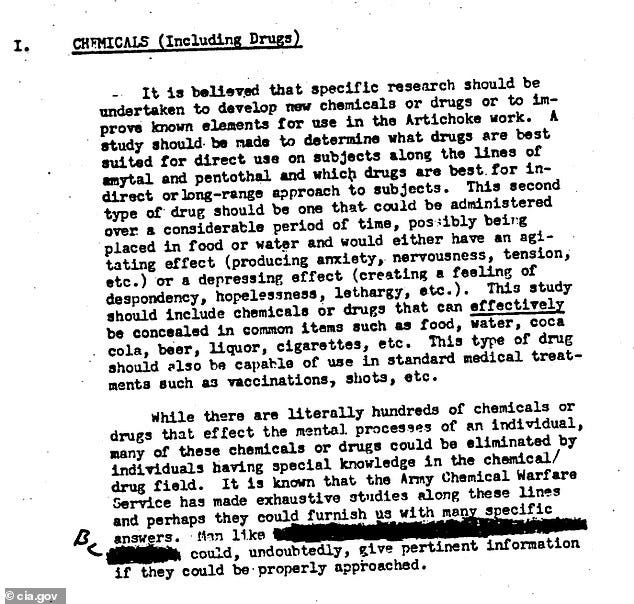
The seven-page document, titled ‘Special Research for Artichoke,’ with an attachment labeled ‘Suggested Fields for Special Research Relative Artichoke,’ outlines proposals to develop chemicals capable of altering human behavior.
It discusses drugs designed for both immediate effects, like truth serums and long-term influence, potentially administered through food, water, alcohol or cigarettes.
Researchers also suggested that such substances could be disguised in medical treatments such as vaccinations or injections.
The CIA was also looking into methods beyond chemicals, listing hypnosis, sensory deprivation, gases and other psychological methods for interrogation and behavioral control.
Artichoke served as a precursor to the CIA’s MKUltra program, which later broadened mind-altering experiments on a larger scale.
Many files were destroyed in the 1970s, leaving the full extent of the research and how far it progressed unknown.
The report, added to the CIA’s reading room in 2025, details the government’s once top-secret Project Artichoke that ran from 1951 to 1956, focusing on behavior control, interrogation techniques and psychological manipulation
Given that the CIA was largely staffed by Operation Paperclip Nazis from the SS, it is no surprise to see the agency’s Project Artichoke being foisted on innocent Americans, with the PSYOP-19 scamdemic and associated Modified mRNA slow kill bioweapon “vaccines” and various transhumanist social engineering scams like 6’ distancing, MKUltra masks, and so on and so forth representing the extension and evolution of said behavior control scheme.
The document was declassified in 1983, but has resurfaced on social media, where users are shocked to see the CIA discussing methods for ‘drugging entire populations.’
Project Artichoke emerged during the early Cold War, a period marked by intense anxiety over communist powers and reports of brainwashing techniques used on American prisoners of war in Korea.
Internal CIA memos suggested that US intelligence feared enemy nations had developed ways to control human thought and behavior, prompting the agency to explore its own capabilities.
The declassified document reveals the depth of this research, noting the need for a study ‘to determine what drugs are best suited for direct use on subjects along the lines of amytal and pentothal and which drugs are best for an indirect or long-range approach to subjects.’
The researchers involved in the secret program emphasized that long-term compounds should be capable of producing ‘an agitating effect (producing anxiety, nervousness, tension, etc.) or a depressing effect (creating a feeling of despondency, hopelessness, lethargy, etc.).’
They also outlined practical considerations for concealment, such as substances that could be introduced surreptitiously in ‘food, water, Coca-Cola, beer, liquor, cigarettes, etc.,’ highlighting the CIA’s focus on undetectable methods of influence.
Moreover, the report recommended consulting with the Army Chemical Warfare Service, noting they have conducted ‘exhaustive studies along these lines’ that could provide specific guidance for the program.
Beyond drugs, Artichoke explored a wide range of psychological tools.
The CIA files discuss drugs designed for both immediate effects, like truth serums and long-term influence, potentially administered through food, water, alcohol or cigarettes (STOCK)
The toxic ultra-processed foods that a majority of Americans consume daily alone can achieve many of these long-term effects of anxiety, nervousness, tension, as well as depressing effects of constant despondency, hopelessness, lethargy, etc.
Add to that never-ending servings of damaging and deadly vaccine doses, the CIA’s nonstop Operation Mockingbird fake news, a school system also infiltrated by the Intelligence-Industrial Complex to turn impressionable young minds into dumbed down and fully compliant tax slaves, skies sprayed with all kinds of caustic geoengineering compounds, crops contaminated with glyphosate and other deadly chemicals, IQ-lowering neurotoxic fluoride added to water supplies, permanent financial stress via a plethora of taxes and unrelenting centrally planned inflation, and you get a severely compromised and sickly population that is far easier to control.
Sections of the document discussed ‘hypnosis,’ ‘psychological techniques’ and ‘gases, aerosols, and oxygen deficiencies,’ demonstrating that the CIA sought to combine chemical, environmental and mental approaches.
Researchers questioned whether such methods could compel individuals to perform actions against their own will, including potentially criminal acts, without leaving conscious awareness of their behavior.
Human experimentation under Artichoke often involved vulnerable subjects, including prisoners, military personnel and psychiatric patients, typically without informed consent.
And then during PSYOP-19 under cover of the criminal FDA’s “emergency” use authorization (EUA), all informed consent was completely stripped away. Shortly thereafter, the gene altering and brain damaging DEATHVAX™ was rolled out:
As this Substack has been warning for many years now, the Modified mRNA slow kill bioweapon “vaccines” induce VAIDS, which in turn may cause brain damage as one of its many symptoms. These cognitive injuries may range from prion-based diseases, to the
Now that there should be little doubt that vaccines induce brain damage, and as such were always part of the CIA’s efforts to control America —the fact that the CIA was intimately involved with NWO globopedo errand boy Bill Gates in the tabletop exercise EVENT 201 that directly paved the way for the PSYOP19 scamdemic should put all doubts to rest — let us now return to the Daily Mail article:
While much of the documentation was destroyed in 1973, remaining files suggested that the CIA and its collaborators systematically explored the limits of psychological manipulation, with ethical considerations frequently subordinated to perceived national security needs.
Artichoke evolved into the more expansive MKUltra program in 1953, which pushed experimentation further, particularly with hallucinogens like LSD.
MKUltra involved hundreds of subprojects at universities, hospitals, and prisons, many of which used unwitting subjects, drawing outrage when the programs were exposed in the 1970s by congressional hearings, including the Church Committee.
He explained he was one of eight convicts in a panic and paranoid state while in MKUltra.
‘Total loss of appetite. Hallucinating. The room would change shape. Hours of paranoia and feeling violent,’ Bulger penned.
‘We experienced horrible periods of living nightmares and even blood coming out of the walls. Guys are turning into skeletons in front of me. I saw a camera change into the head of a dog. I felt like I was going insane.’
It was not just Whitey Bulger that was experimented on and handled by the CIA, but also the likes of Charlie Manson (Chaos: Charles Manson, the CIA, & Secret History of the Sixties), Lee Harvey Oswald, Jack Ruby, Sirhan Sirhan, James Holmes, Ryan Wesley Routh, Thomas Crooks, and many others.
And is it really any wonder that war agencies like the DOD and Pentagon are the main patent holders for the C19 “vaccines,” and that their CIA coconspirators were behind-the-scenes manipulating MKUltra masked up Americans into subjecting themselves to these deadly eugenics injections?
The spirit of Project Artichoke is very much alive and well in America, and we can be certain that the CIA has many more followup psyops on deck for We the People.
From Brave AI: Young Adults (18–25 Years): This group has the highest prevalence of mental illness in the U.S. In 2024, 32.2% of young adults aged 18–25 experienced a mental illness, with 1 in 10 reporting a serious mental illness. Rates of any mental illness in this age group reached 33.2% in 2024, significantly higher than the national average. This age group also reports high levels of suicidal thoughts, with 3.8 million young adults having serious thoughts of suicide.
Adults (26–49 Years): The prevalence of mental illness is high but lower than in young adults. In 2022, 29.4% of adults aged 26–49 had any mental illness, with 23.1% of all U.S. adults experiencing a mental illness in the past year. This group shows increasing rates of mental health challenges, including depression and anxiety.
Adults (50+ Years): The prevalence of mental illness is lower compared to younger groups. In 2022, 13.9% of adults aged 50 and older had any mental illness. However, this group faces unique challenges such as loneliness, grief, and comorbid physical health conditions. Despite lower prevalence, 71.0% of adults aged 50+ with serious mental illness received treatment in the past year.
Children and Adolescents (3–17 Years): Mental health issues are common in youth. In 2022–2023, 11% of children aged 3–17 had diagnosed anxiety, 8% had behavior disorders, and 4% had diagnosed depression. Nearly 1 in 5 adolescents (ages 12–17) had a major depressive episode in the past year, though rates declined slightly from 2023 to 2024. XXX
So, what can we learn from this? Well, whatever they're doing it's now targeting the under 50 crowd, and mostly targeting the under 25 group.
As for Autism, could this perhaps be a control tactic?
If our own government won’t step up and prosecute and shut these operations down, what is our recourse? we have none! we’re gonna go at them with our little pistols and rifles to what end? just to be blown up by the next SWAT team. ??? I’m so disheartened by the lack of focus on the harm that’s being done to the American people through
Our air, food and water. It just needs to stop. To us it’s so obvious, so I’m not sure where the holdup is or why they are not seeing it. (like this whole glysophate thing ) I think the right is afraid of the left. I guess and rightly so, the left can react pretty psychotic.
I have read other articles. I wish I could cite them here, but I apologize. I can’t, where “there’s a lot more of us than them. They are just louder“ And now obviously more violent. Come Lord Jesus come.




From Brave AI: Young Adults (18–25 Years): This group has the highest prevalence of mental illness in the U.S. In 2024, 32.2% of young adults aged 18–25 experienced a mental illness, with 1 in 10 reporting a serious mental illness. Rates of any mental illness in this age group reached 33.2% in 2024, significantly higher than the national average. This age group also reports high levels of suicidal thoughts, with 3.8 million young adults having serious thoughts of suicide.
Adults (26–49 Years): The prevalence of mental illness is high but lower than in young adults. In 2022, 29.4% of adults aged 26–49 had any mental illness, with 23.1% of all U.S. adults experiencing a mental illness in the past year. This group shows increasing rates of mental health challenges, including depression and anxiety.
Adults (50+ Years): The prevalence of mental illness is lower compared to younger groups. In 2022, 13.9% of adults aged 50 and older had any mental illness. However, this group faces unique challenges such as loneliness, grief, and comorbid physical health conditions. Despite lower prevalence, 71.0% of adults aged 50+ with serious mental illness received treatment in the past year.
Children and Adolescents (3–17 Years): Mental health issues are common in youth. In 2022–2023, 11% of children aged 3–17 had diagnosed anxiety, 8% had behavior disorders, and 4% had diagnosed depression. Nearly 1 in 5 adolescents (ages 12–17) had a major depressive episode in the past year, though rates declined slightly from 2023 to 2024. XXX
So, what can we learn from this? Well, whatever they're doing it's now targeting the under 50 crowd, and mostly targeting the under 25 group.
As for Autism, could this perhaps be a control tactic?
If our own government won’t step up and prosecute and shut these operations down, what is our recourse? we have none! we’re gonna go at them with our little pistols and rifles to what end? just to be blown up by the next SWAT team. ??? I’m so disheartened by the lack of focus on the harm that’s being done to the American people through
Our air, food and water. It just needs to stop. To us it’s so obvious, so I’m not sure where the holdup is or why they are not seeing it. (like this whole glysophate thing ) I think the right is afraid of the left. I guess and rightly so, the left can react pretty psychotic.
I have read other articles. I wish I could cite them here, but I apologize. I can’t, where “there’s a lot more of us than them. They are just louder“ And now obviously more violent. Come Lord Jesus come.