William Farrington and the Pedophile
Why did William Farrington cover up for Jeffrey Epstein, the world's most famous child trafficker? A forensic review of "those" pictures.

We’re going off-topic today to post something a little bit different, although it seems increasingly that everything is connected. And obviously everybody knows that Jeffrey Epstein didn’t kill himself resulting in a never ending stream of memes….

The subject of interest for today’s article centres around the two pictures below. They are of significance in the scheme of things and highlight everything that is wrong and corrupt about the media and the personalities that run it.
Both pictures are taken from this article from the New York Post, who got the “scoop” on the pictures of the dead Jeffrey Epstein. (archived here)

Now, it is necessary to understand that this headline of 10 words is a lie. Three journalists (who weren’t actually there so were merely reporting some pictures) were required for one short article in order to propagate the lie - Larry Celona, Eileen Connelly and Emily Saul. The article covered up for Jeffrey Epstein. The person that enabled the lie was one William Farrington, who photographed the event.
Here are the photographs. For fun just have a look at them for a minute before continuing, and then click on the poll following the pictures to put your marker down on what you think they show (don’t overthink this, just pick whether you think they show what the headline says).
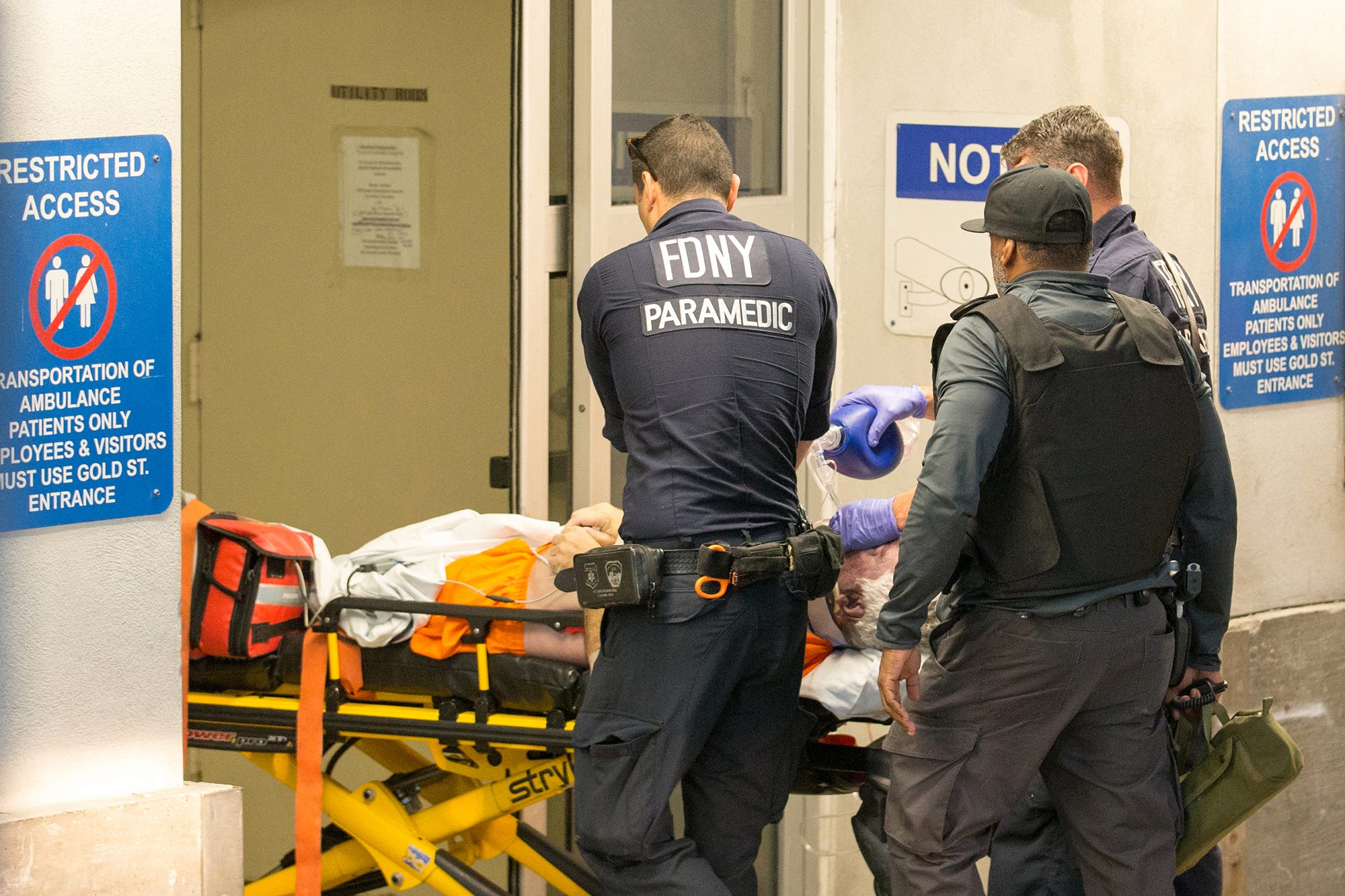
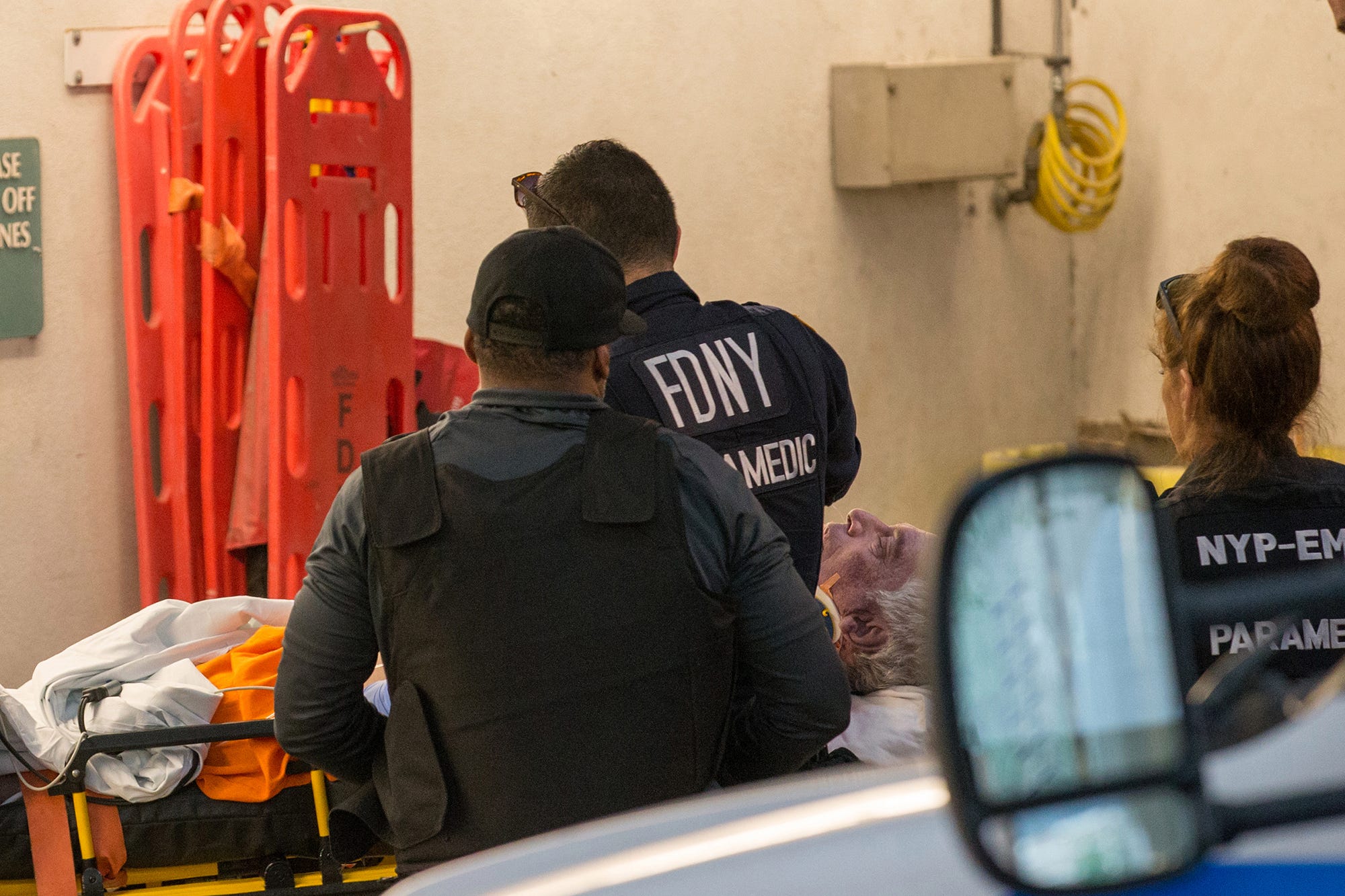
POLL
Do you think the pictures show "Jeffrey Epstein" being resuscitated and wheeled into the hospital then a picture of him after being declared dead, or something else?
Those pictures were grabbed directly from the NY post website the day they were posted. The security on the site is lax (maybe deliberately) and so the original jpegs with EXIF data are there (in order to get them you have to remove the strip command from the URL - I’ve done it for you here: [picture1] [picture2]).
The EXIF data looks like this

From this you can see the following:
The photographer is William Farrington
The description is “a patient being moved from the Federal Correctional Center to DNYP hospital, early saturday morning” (consistent with the headline of the article)
The photos were taken around 7:24am 1, edited in photoshop 8:40am and the article published at 9:49am (New York time, 10th August 2019)
Photo 1 (with the bag/tube in place) was taken at 7:24:20 and Photo 2 (without the bag/tube in place) was taken at 07:24:12
Photo 1 was edited first (but taken second). Photo 2 was edited second (but taken first).
If you’re not familiar with EXIF data I should point out that any of this data is editable. However, it appears that William Farrington edited the description and author as standard practice but is unlikely to have edited the time stamps as that would be unusual.
The first deduction from this information is:
[Takeaway 1] The picture without the tube/bag was taken first, and then the tube/bag was loosely placed in order for the second picture (portrayed as the first picture) to be taken, 8 seconds later. The alternative explanation, that the second picture was actually intended to show Epstein being taken off the ambulance and immediately wheeled into the hospital - i.e. that there was nothing strange here other than the order the pictures were shown in the article - would mean that there was no bag/tube resuscitation taking place in the ambulance. Either way, it’s a set up.
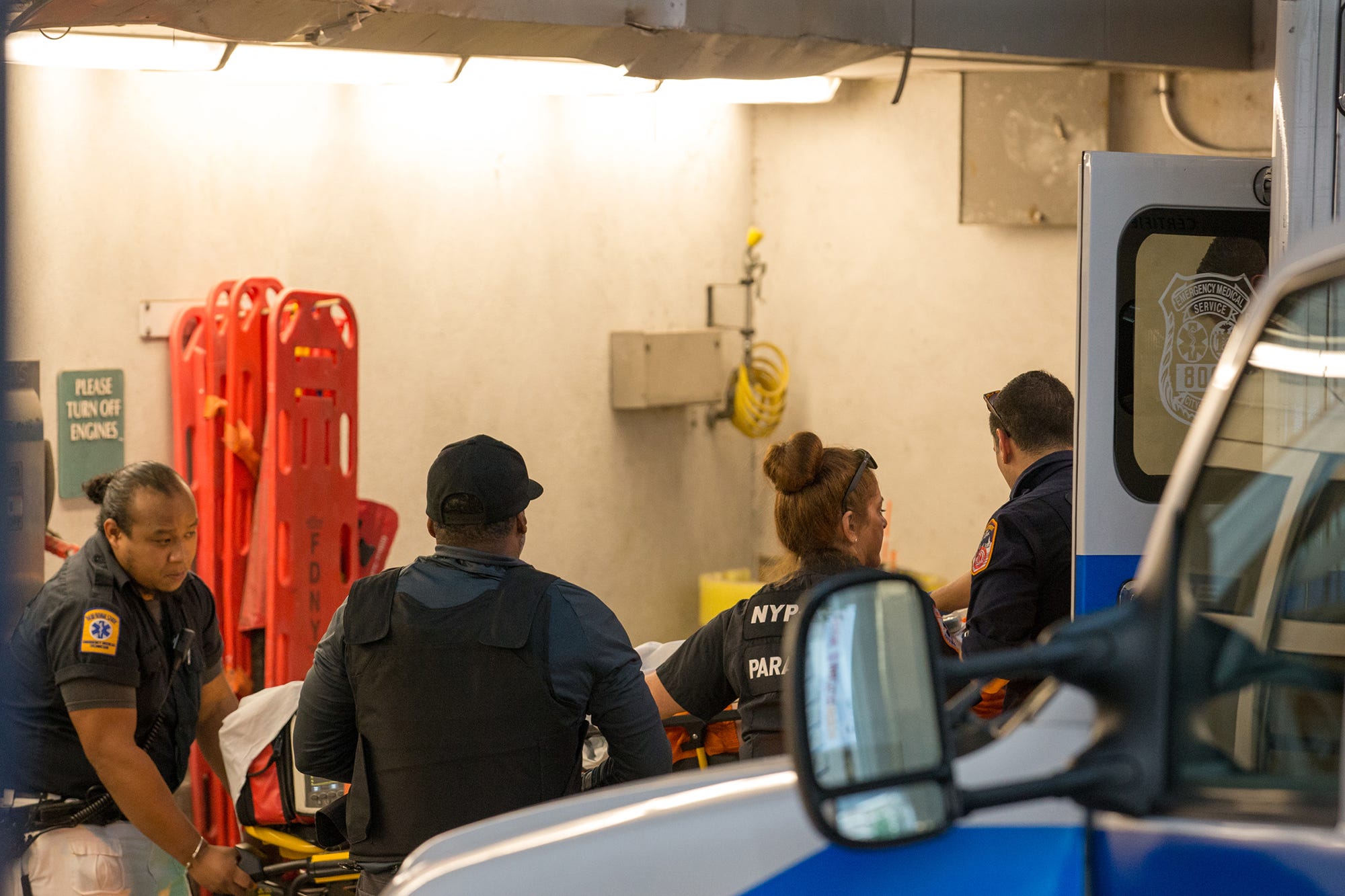
Now let’s look at the first picture again with some annotation

There are a number of anomalies in this picture, and it’s probably easiest for me to list them:
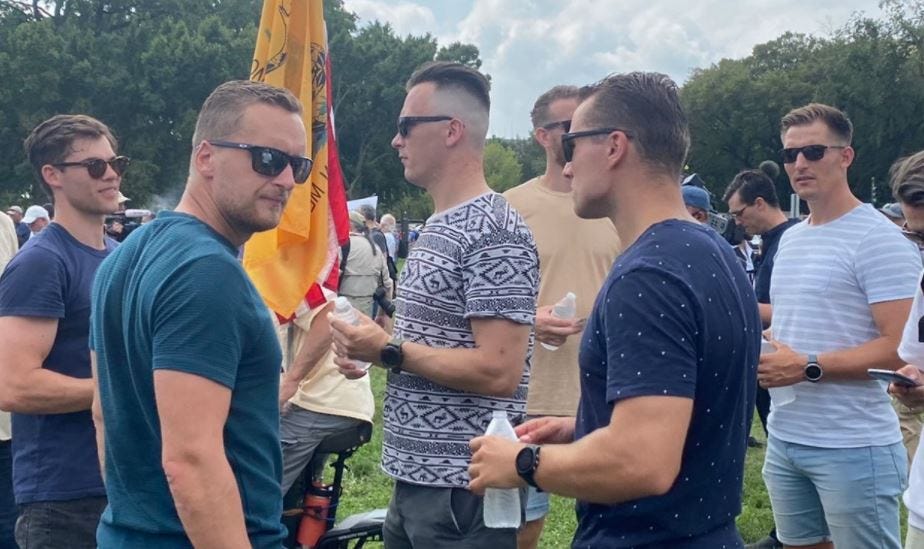
The paramedics look like something out of a movie/FBI agents*
Epstein’s arm is bent. If you are being resuscitated this can’t happen. Note that it is also on the outside of the bed side. This can’t happen for a dead/unconscious person. The arms would be by the side of the person if the bed sides are up (otherwise it’s too dangerous to move the gurney with arms flopping about).
The ET tube (endotracheal tube) doesn’t look like it’s in the mouth where it should be. According to the picture timestamps it was placed within 8 seconds of the previous picture at the same time that Epstein was being rushed into the hospital. The simplest explanation for this is that it’s not an ET tube, it’s fake.
The gurney does NOT go through the doors . Yes the doors are open and it looks like they are going through the doors but there are no pictures inside the hospital (see below).
The athletic paramedic pretending to do CPR is not doing CPR. He also wasn’t on the other picture and if he was doing CPR he would have been on both (because you wouldn’t continue CPR pushing a gurney through a door if you weren’t already doing it).
*here are some more FBI agents who infamously just happened to be at the “Justice for J6” rally 2 on Sept 18th 2021, sightseeing (😉)
Let’s recap at this point to avoid any confusion: The NY post portrayed these images as showing Jeffrey Epstein being wheeled as an emergency into the New York Presbyterian Downtown hospital with a resuscitation effort underway, and then a second picture showing him dead after the resuscitation effort.
This was a lie because the “dead” picture preceded the “resuscitation” picture and Epstein never made it into the hospital.
[Takeaway 2] The New York Post purposefully misrepresented the resuscitation of Jeffrey Epstein, which didn’t happen
Of course, this was obvious at the time to most of us who have ever performed resuscitation - because you cannot resuscitate a corpse. Jeffrey Epstein was supposedly found dead in his cell at 06:30 AM and declared dead at the Manhattan Correctional Center. So any resuscitation effort was obviously going to be fake, assuming he was actually ever dead.
In addition to this, it is clear from these pictures that Jeffrey Epstein’s body never made it into the NYP hospital . Why? Because the second picture (the “post-death” picture with no resuscitation efforts) was not taken inside the hospital - it was taken in the ambulance bay.
Here’s the proof, the pictures below are taken from Google street view images of the ambulance bay of New York Presbyterian Downtown hospital on Gold St.

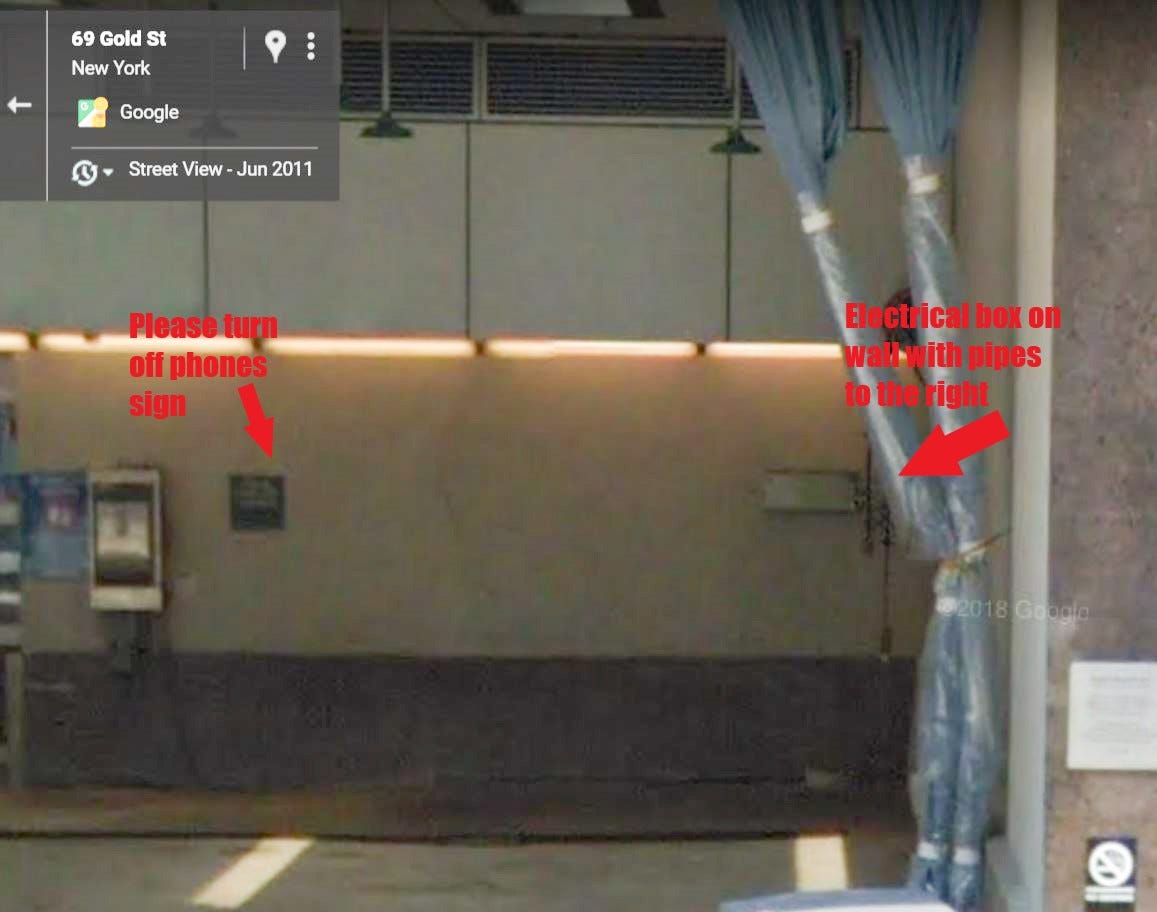
You can clearly see the red body boards and the electrical box on the wall, which appear in the “post-death” picture, adjacent to the sliding doors that the gurney was being pushed through. The picture of a dead Epstein was taken in this ambulance bay. This fits with the time stamp. It’s worth noting that the New York Post article is set up for plausible deniability because the second picture was captioned “Jeffrey Epstein is wheeled into New York Downtown hospital” - even though no wheeling was going on in that picture, there was no ET tube and it was posted after the gurney-through-the-door picture.
Things get a little more interesting in the weeks after those pictures were first posted and I drew attention to the fakery on twitter…. Of course I wasn’t the only to say that Epstein didn’t kill himself (which became a huge meme). The New York Post had to do some dancing to rebut he Hilltop Hoods in November in this article (archived here).

Bizarrely, a new picture from Farrington pops up in that article, and this is it:
The picture wasn’t released with the others in August but was modified and saved by Farrington just for the Hilltop Hoods article. The timestamp 3 is a few seconds before the “dead Epstein” picture.

Now you know that we are in the ambulance bay you can see that there are also two extra players who disappear into thin air. These are the overweight guy on the left and the tall guy on the right. They also have paramedic patches so are a bit more likely to be genuine than the FBI/actors who quickly take over from them. It’s interesting that Farrington has to scrabble around 3 months later to create a new picture in photoshop and publish it, rather than using the original picture. There had to be some problem with the narrative that needed to be dealt with.
Note that the time it took from dropping Epstein in the ambulance bay on the Stryker gurney, to pushing the gurney into (not through) the doors was 11 seconds. In that time they got rid of two staff with EMS patches on, and replaced them with two FBI lookalike staff (no EMS patches). This must have been a pre-planned pre-rehearsed operation taking a total of 11 seconds in which time at least 3 photos, cleverly positioned to give away minimum information, were taken.
Within hours of the “death” a body was collected from the rear entrance of the hospital somewhere. You will notice from this picture the same fat escort guy and some other guy that has a pretty intense stare. There is no way of knowing who is in the body bag of course, but the bag is going into the state coroner’s van. William Farrington’s name is on the photo which means that either this photo was taken before he went back to his computer, or else he came back later in the afternoon, which is when this picture was taken according to the Daily Mail and also appears in this article.
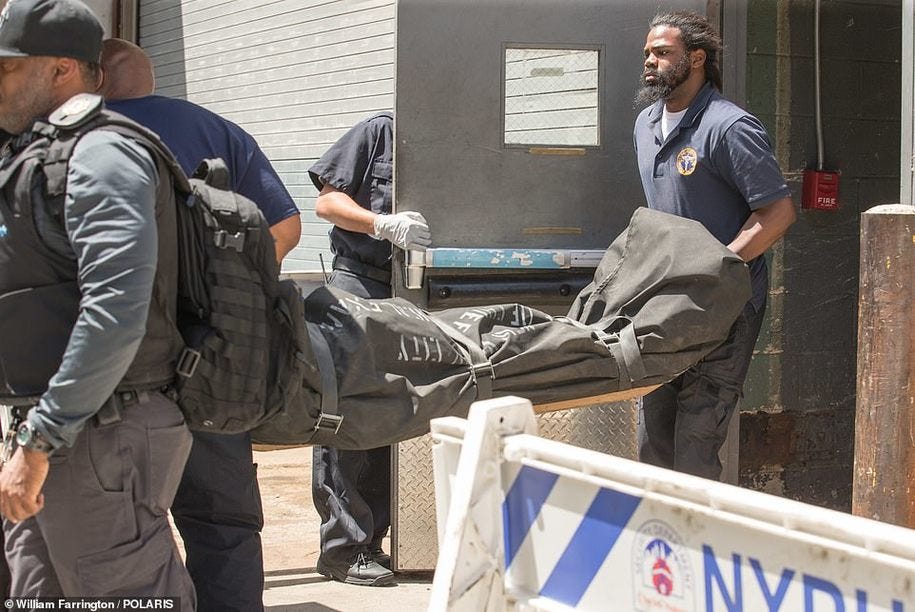
Interestingly the same article describes the fact that there were two state medical examiners’ vans at the hospital - one at the front and one at the back. Both apparently took “a body” and the one at the front was loaded up and driven away in a bit of a staged fanfare for the press…

“But the autopsy pictures” I hear you cry…
Well I don’t know who they were but they almost certainly weren’t Jeffrey Epstein. The autopsy pictures shown on 60 minutes are either shockingly bad quality or gorily close up (but with no facial features for identification).
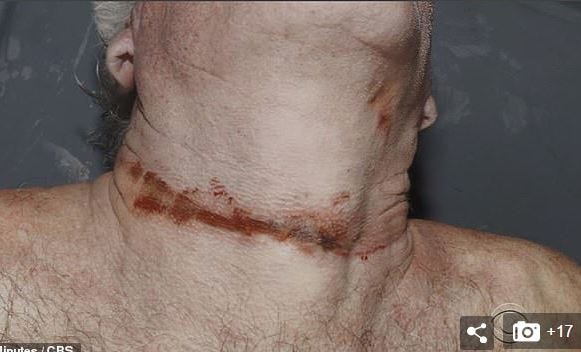
Note in this picture they have put the ET tube back in for the picture. This would be pointless once someone had died, when the ET tube is generally removed. They also dressed the dead body in a new gown when they took off the orange prison pants. Like you do. (OK, I’m being sarcastic, this picture isn’t Jeffrey Epstein - apart from anything the chin is too narrow and arms far too hairy).
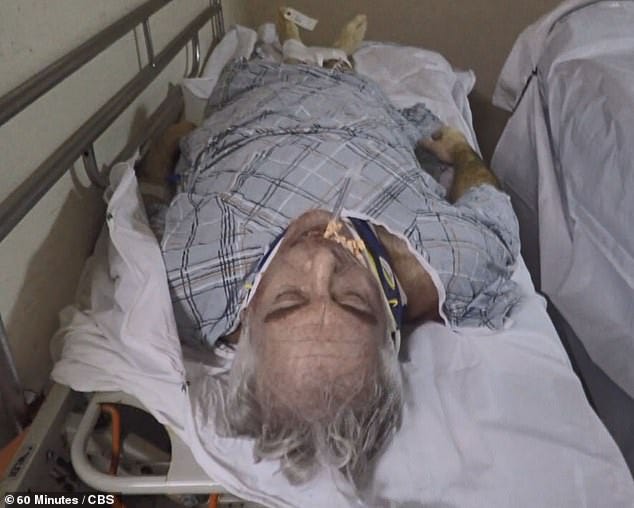
The clincher to this - and that the media were heavily involved in the cover up of Jeffrey Epstein’s “death” - is this picture right here from the 60 minutes autopsy file:
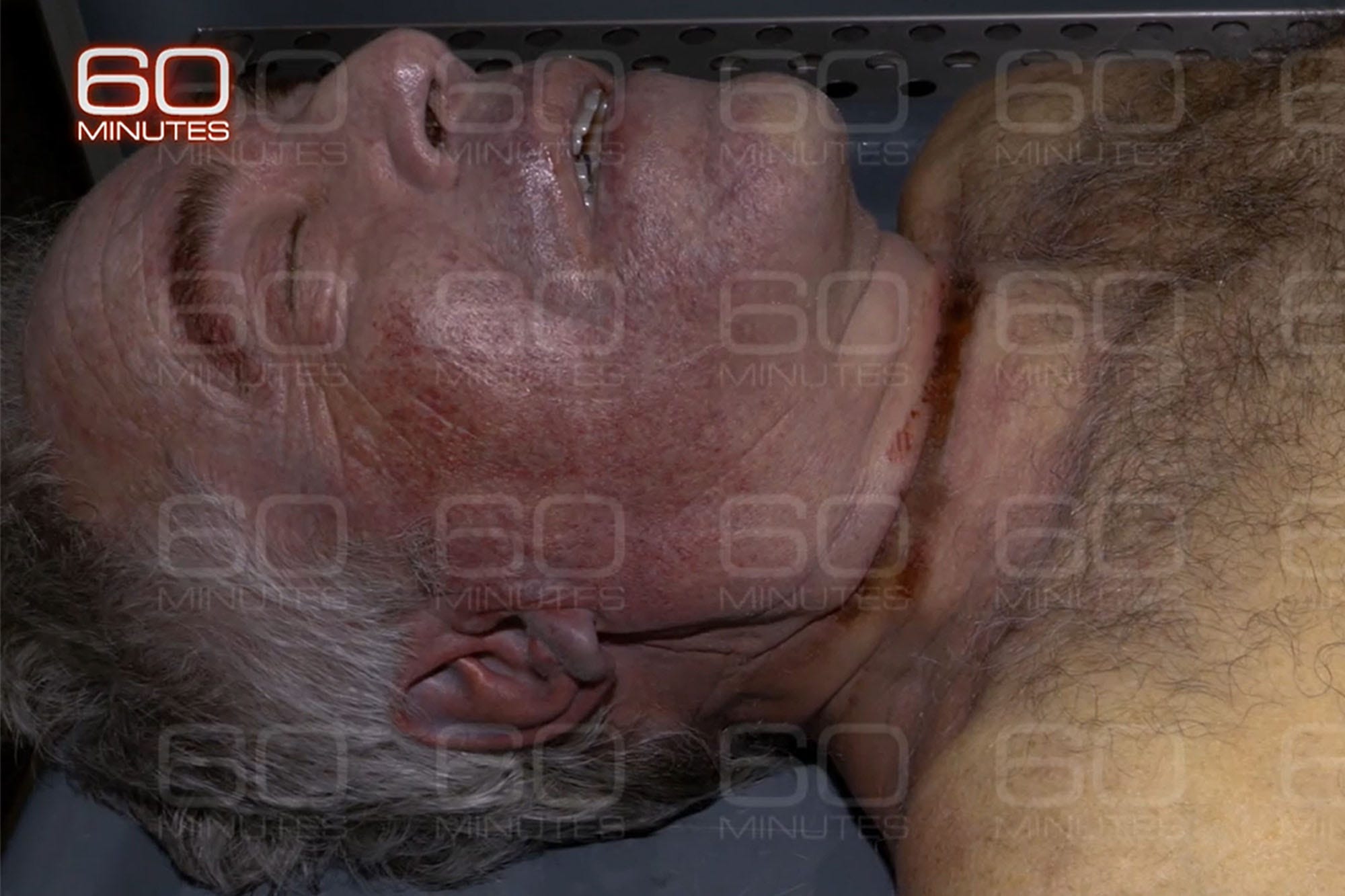
Yep. As you can see the thin ligature mark (not possibly made by a bed sheet) is there, and then there is this weird shelf to the face at the ear lobe. What the hell is it? It’s a mask (and it isn’t there on the picture above it). It’s a latex mask used for acting and theatre. Nobody’s face looks like this. The ear is a giveaway as they have rushed it and left the poor guy with almost 2 ears. We can’t even be sure this person is dead as opposed to made over, but if he’s dead it’s almost certainly someone else.

It’s also quite possible that the reason that there was so much controversy over the way the gurney-Epstein didn’t look like actual-Epstein was again because the gurney-Epstein was wearing a mask to make him look dead (for William Farrington’s camera).
Who is William Farrington?
And on that final note, who actually is William Farrington, a photographer who is prepared to cover up for the most famous pedophile on earth?
Well it looks like Bill Farrington is Roger Farrington, as seen here and explained more fully here. It looks to all intents and purposes that Bill Farrington (Clinton and Epstein photographer) and Roger Farrington (music photographer) are either identical twins or the same person.

One thing’s for sure - Farrington didn’t want to talk about his world famous scoop. Bizarre, really because if you are a media photographer who got a scoop I would imagine you would want to tell another journalist all the tips you used to get it, but what do I know?…
So, let’s recap.
What we know is this:
The photos of Jeffrey Epstein taken in the ambulance bay at New York Presbyterian Downtown were staged. William Farrington was tipped off to be there and the whole thing passed by in 11 seconds. Three photos were taken and one was withheld until November after questions had been asked. Some of the people in the photos are not paramedics, not doing CPR, and they may not have even entered the hospital. The autopsy pictures are completely inconsistent and staged. The body they are transporting is not a dead body and not being resuscitated. The whole thing is fake and William Farrington knows.
The explanation must remain as speculation but my guess is this:
The body in the pictures is Jeffrey Esptein, alive, with a mask on to look dead. CPR did not take place and his body is transported (using the decoy state medical van) out of there and into a witness protection program.

One thing, however is certain.
There are at least 4 people in those pictures who know exactly what happened and are covering up for one of the worst pedophiles in history.
It’s not the first time it’s happened and it won’t be the last:

The mainstream media not only protects pedophiles like Epstein, Savile and those celebrities involved in that web (you know who you are) but they have spent the last few years preparing to propagandise the world into medical coercion on an unprecedented scale, probably killing millions in the process.
Not only did the media cover up Epstein’s pedophilia and even his death but you will never hear a word about the proven involvement of Epstein’s co-conspirator in the higher echelons of the NHS 4 5or the many webs of corruption that we have been trying to uncover in these last 3 years.

Those in the media that knowingly hide serious crimes and cover up for the worst criminals in society are enablers. The glimmer of light is that more and more people now know that they are, and it is getting harder for them to hide it.

There is a tipping point where the public cease to believe “the news” entirely. Once that happens “the news” will no longer be able to protect the likes of Epstein, Junkermann and Maxwell and their hangers-on. The clamour for prosecutions will be relentless - not just for the perpetrators but the enablers.
Meanwhile, aren’t you glad that there is a new UK government that will be able to rout out the corruption embedded into the NHS?
Yeah, about that…


The final word on Epstein, the media and the cover ups should perhaps be left to the Babylon Bee who got their twitter account restored today. It really says it all.


1 The EXIF timestamp is set by the camera, many of which are not internet connected and therefore do not automatically update for daylight savings. 7:24 in the EXIF timestamp appears to be 8:24 (see footnote below).
2 Thanks Tom for the correction!
3 The EXIF timestamp is 7:24 but the description is 8:24. The description is manually added during the photo editing process. This is what you might expect during daylight savings if the photographer has not updated the DST setting on the camera.
4 https://www.gov.uk/government/news/health-technology-expert-panel-meets-for-the-first-time (archive)
It is notable that the only remaining picture on the internet in which you can identify everybody is here (archive). That picture clearly originated from the gov.uk article which now only hosts a picture with resolution 300 x 195 pixels.
In other words, the UK government was told to reduce the resolution of the picture on their website so as to obfuscate the identification of Nicole Junkermann and Ben Goldacre.
5 It should be noted that Ben Goldacre was one of the main protagonists (along with Surgisphere, Richard Horton, the NEJM and David Boulware) involved in shutting down hydroxychloroquine usage for COVID-19 with his paper in Lancet Rheumatology, showing negative efficacy for the drug. The paper was highly unlikely to be real but the authors refused to release the data despite being funded by the government. The OPENSAFELY platform was a parallel project for HDRUK - the very group involved with Nicole Junkermann.

Do NOT comply.
Ok well just look at the autopsy picture that only shows his neck. The earlobes in that picture are very distinct. Kind of bent in half. I googled a picture of Epstein while alive and his earlobes look nothing like that.
I've been an EMT for a few years and have work a number of CPR calls.
While protocols vary slightly between departments and states, I think there are some things that should be constant in how such calls are handled. For one, we stay on the scene when doing a CPRresuscitation until ROSC (return of spontaneous circulation) or until the code is called. While EMTs are not allowed to call a time of death in a resuscitation, paramedics are. If the FDNY folks who responded to the suicide call were paramedics, they would have worked Epstein until it was clear that the guy wasn't coming back. Typically (again, I do not know FDNY's protocols), if fifteen minutes of continuous CPR and the injection of epinephrine and magnesium sulfate do not re-establish some rhythm, the paramedics will call a time of death. It is very important to stay at the scene for two reasons. The first is that good quality CPR is very difficult to maintain while moving the patient to, and transporting them in the ambo. The second is that upon death, this is now a crime scene. The police and the medical examiner will need to see the body at the scene. In EMT schools at every level of certification, we are warned about messing up a crime scene, and taking away the body is the worst way to do that.
I do concur that the ET tube does not seem to be inserted far enough into the patient.
When the patient is declared dead, nothing is removed. The ET tube stays in place. If the patient had made it to the hospital alive, he would not have been pronounced in the ambo bay and would not have had the ET tube pulled there.
Fishy, very fishy